The Blue Book of Nebo: a Teaching Primer

BBC: The Blue Book of Nebo: serialised narrative reworking

Spoiler alert. Contains plot references!

These are a few personal notes and, of course, not prescriptively how to do it, but things that could be worthwhile thinking about when approaching a text like The Blue Book of Nebo. 

I think that because the work is slim, their attention is the key thing. Actually, with Y8, developing better focus and attention is a key thing. This slim text offers them the chance to do so. Contemplation. Reflection. Wonder. Creativity are the soft skills that are developed alongside critical textual analysis.

The themes of this book are things such as love, loss, reflections on community, growing older, growing apart. I’d really impress upon them that this novel is a tool for developing empathy, and that empathy and understanding the human condition is the most important thing about why we read books.

I’ve been insisting with my Y8s that they tune in better. This is because this book is a work of literature, and, as such it focuses on the human condition. If you aren’t paying attention, you won’t get it. The book can be considered like a slim volume of poetry. 

Listening to Mannon Steffan Ros’ own folk music, as well as enjoying listening to songs about Wales and Welsh culture can be very enjoyable. And just get them to listen to one song really closely. The language might be Welsh/(Gaelic) but that shouldn’t matter too much. What’s the emotional resonance of the piece etc.?

Because this book is slim, you can use it as a catalyst for creative, artistic, meditative reflections. You might want to think that there are 26 or so “chapters”, but some of these are just a page or two long. Many are about 3 or 4 pages. Mona, Dylan’s sister dies. And that is really sad! If they aren’t listening this will be totally lost.

The lessons on Welsh culture are very good. Rees is a Welsh name, so I, of course, lean into this. And Swansea, where my great great grandparents are from is quite close to where Nebo, Anglesey and other geographical places named in the first chapters take place. They should find these on a map and take a walk in the landscape.

Welsh mythology: this is central to the Welsh identity (DRAGON on flag!!) More of this when you meet Dave. But the Welsh have been oppressed by the English through the ages so are fiercely independent, warrior spirited, (see the 6 Nations, although choose your Youtube clips wisely as they just got pumped by the French!)

A whole lesson can be done deconstructing the book jacket and blurbs. You can find some art materials and get them to make their own front covers, as per the guidance in the opening lessons. But if they are to do this really well, it could take the whole lesson. There are some amazing artists in that year group. Think pencil crayons, as well as water colours. See if you can get in the art room but there are English sets of materials around.

With a novel this size, I wouldn’t worry about doing it in a hurry, nor doing it to death. The Y8s really enjoy being read to. Only later in the novel, once you’ve established how to read character’s voices, intonation etc, should they have a go. 

I’ll share a few resources I have used to prime them for listening closely. Some of these you will insist they write down, others will come out in conversation, others you want to be aware of and not share with them to try not to kill the text. It’s a case of reading the room and seeing what they might be up for, and insisting some things are done well, but giving opportunities where you can take your foot off the gas. 

Music is a very good way of setting the mood. The book is a diary. They could keep a diary. 10 minutes at the start of each class to set the mood. They have all got memories of the Covid pandemic.

Here are a few activities that I have done to prime the idea of looking and listening really closely…

Front and back covers. Read the back cover with blurb and certain details are given about the plot, character, situation.Images: what is depicted, what are the connotations?
The Moon: large, bright, immense, mystical, dominant, lights the way, magical, fantastical.
The starry night: no light pollution, stars light the way, mythology, cosmos, gods, navigation, point the way
Colour connotation: Blue, melancholy, night time, peaceful, like the oceans, dark, vast, no light pollution, dark, lost, wilderness
The hills and the sea: Welsh landscape, rolling hills, natural, small village, isolated house, no other lights, far from habitation
The house: small, neat, isolated, cosy, lean-to, countryside, cottage, Welsh slate
The radio tower: dark silhouette. No lights. No electricity. Darkness. Communication broken. Isolation. Dystopian.
The orange figure: Dylan. Small boy. Bright orange, energy, hope in darkness. He is alone, looking up. Hope? Lost? Alone. 
The orange ladder: ladder leading up, symbolic, connects to the boy, we can imagine a narrative, something about transformation, elevation, looking out, perspective. Future? Past?
The medal: Carnegie winning author. Young adult. So, take it seriously.
The quotes: Glowing praise from serious critics. Superlative language.

BRYNEGLWYS | Manon Steffan Ros

The author’s own folk song. Language does not matter. The film is its own language. It’s a given that the Welsh film producers speak Welsh, or communicated with the author of the meaning. But without, you could draw their attention to: hills, nature, journey, loneliness, sadness, tenderness, lost communities, mining, weather, (presumably she is walking along the Brecon Beacons), Welsh slate, rugged, rough, windswept. Musical cues: rhythm, tone, tempo, emotional range, pace, feeling.

Manon Steffan Ros – Empathy Walk 2022 (English)

Empathy Walk: this is a very easy to adapt creative writing resource. In this 5 minute walk around town, we can see a Welsh town that would look very much like the fictional (I am guessing) Nebo. We can get a sense of who the author is, and after hearing her lovely song, they might care more about what she has to say. She looks about the same age as Rowenna and that could be important. I wonder if she is a mother? 

We can notice the author is very attentive. She zooms-in on key details like a broken seagull egg and reflects on the loss of life. She reflects on her own thoughts and feelings, and displays compassion for others. A walk to the temple to try and model this would be very useful and bring calm on a busy teaching day (each of their days are busy and they love a fresh walk..)

One thing to be aware of is that the Y8s all feel very strongly about their mothers. When they stop being a bit annoying and chatty, they are like babies to some degree, still! I would not make this explicit or talk about it. But where there are moments of conflict between the mother and son, when you are reading the text, and you can see they are engaged with the reading, sometimes just a pause is enough to let them think about that moment that they called their mum a name and regret it. When they read about the characters, they are reading about themselves, to some degree. They have been in similar situations, relationship arguments etc.

It would be worth checking with Nelly just in case any of your class have lost a sibling or close relative yet, as this book will cut raw for them.

The comprehension activities are all well worth it. Write in full sentences. Show your best handwriting. They can write about what they learned from the last lesson while a song is playing. You can model this. You will write more than they can, for the most part. For those with attention issues, they should then copy what you wrote on the board so they have something. You can play another song and go again. There is a lot revealed within the first couple of chapters and these first couple of chapters are where the most attention should be placed. 

If this is the only novel they will read in Year 8, and I think given how often many of mine constantly circle back to just The Diary of a Wimpy kid, then, this novel is really important. The Blue Book of Nebo is what Dylan calls this book, and he is setting against other of the great Welsh mythological texts, so, you can try to impress upon them that this is a “sacred” text. You could think that for each lesson you might focus on just one thing, and maybe that is the life lesson that you want to teach them. It won’t be in a teaching guide- it will be what you think is important about life itself! Being kind to others, being at peace with yourself etc. etc. 

They can produce art of any creative writing while songs are playing. There’s a great bank of Welsh folk songs out there to explore, but any music that is soft, “folksy” works. 

Here are some songs that we have played and they have enjoyed. 

SPINE-TINGLING! 🏴󠁧󠁢󠁷󠁬󠁳󠁿 Dafydd Iwan belts out Yma o Hyd before Wales vs Austria!

From the last World Cup. This guy absolutely belts it out! Doesn’t matter what the words are- but they can be looked up. Look at the joy. The singer is in tears at the end of it. Why is the old man crying when singing you might ask? Tears of joy, belonging to a community. Honour and pride. This is perhaps the greatest moment of his life. Fathers and sons are hugging and singing together. 

Welsh National Anthem just before Wales beat England 30 – 3.Saturday 16th march 2013

Again, really powerful, stirring stuff. At least one of the Welsh players is in tears. This is what they/we all missed during Covid. Have they ever been to a live concert? A live match? The atmosphere here is electric. Youtube can’t really do it justice. Point this out to them, just how important human connections are in the smartphone age. But quiet private moments can be just as intense too, and meaningful. The novel is full of the latter.

SENSATIONAL Welsh Male Choir Has Judges In TEARS In Britain’s Got Talent Audition 2023

Modern, contemporary. The Y8s chose this as they like X Factor etc. One of the judges says she knew she would cry as soon as she heard Welsh choir. Why is that? How do they react to the performance? Why is it so powerful? 

Other songs and videos

A Church of England club-banger! 

Male Voice Choir Flashmob – Wales vs England RBS 6 Nations 2015

Fleet Foxes – White Winter Hymnal (OFFICIAL VIDEO)

Think the Fleet Foxes are American, but anyway, folksy, soft, nature, harmony…

Is Full album

Chapter One: Dylan

I think that you can lean into their relationship with their mothers a bit. Just be aware of it, at least. When your Y8 reads, “Because (mum) can’t be bothered to teach me”, I wonder how many of them think about their mums. Those that did and what that meant. Those that didn’t and let the helper, or school, do it. There will probably be many like that. And I would keep all that to myself. But that’s a good way to start to think about how to read the book to them.

They often have younger brothers and sisters, or are one. You could talk about attention. They could write about their sibling or friend relationships later on.

“Sometimes I think it’s impossible for someone to be as beautiful and as ugly as my mother.” 

  • They react to this line. They have all probably said something mean to their mum, or are ashamed to recognise that they have thought something like this. Just catch their eye. If they drop your gaze, you know the meaning has landed and they are listening to the story. They want to know more about how people like them feel about their mums…

Make sure they pick up on all the cues about the dystopian world. No biros? Hmmm. No people. Find where they are on a map. Draw the map out. The lost names. Their primary school. 

Sunnydale: important later. Look through the windows. Why don’t they take stuff from their neighbours? 

How Dylan is adaptive, resilient. Kills rabbit. This is important later.

Chapter Two: Rowenna

Details of “The End”. What happened? Rowenna’s struggle to write. 

Here, I wonder if they ever empathise with the fact that their mother is/was before them an actual person? I think some of them will feel quite acutely the sense of loss or indifference, or not enough time, or really their relationship might not be that good. 

I would avoid dwelling on their own relationship with their mothers. You don’t know what demons lurk there and it could be very dangerous to bring to the surface very painful and personal feelings. But the quiet chance for some of them to reflect about these ideas is kind of what this novel/novels are all about. When they are writing as Dylan about his mother, they are, kind of, writing about their own feelings about their own parental relationships…

Gaynor: a quiet character but I find her hugely affecting. There is the human decency or her protection of Rowenna, kindliness to Dylan, the role she plays as a central figure within the community. 

P. 17: “You can come and live with us if you like.” What does that mean? It means that Rowenna, and Gaynor, who has let her leave early, realise that the world that they are living in is collapsing. It also reveals that Gaynor, herself, doesn’t have anyone. Gaynor realises the importance of the gesture and can’t reply as she would cry. She carries on cleaning and says nothing. They will miss this. There’s a bit later on when Rowenna talks about the ladies that visit her and it’s a place of ritual and community. She is essentially a counsellor within the community. There’s something that Mannon Steffan Ros has to say here about the quiet people, who are pillars of the community, that are working class, maybe not so empowered, but actually are pivotal to society. And those relationships and close-knit communities are becoming lost in the modern world.

The Black Book of Carmarthen, The Red Book of Hergest- Welsh tales and legends. The Legend of Brave Gelert is a really good short story about a brave dog! 

Dylan Thomas has a beautiful Welsh voice. They could do worse than write out his poem in their books. 

Interstellar – Do Not Go Gentle Into That Good Night Scene 1080p HD

Great modern interpretation. In a similar kind of way, Interstellar is also about love and loss, a breakdown of human connection.

======================================================================

Lesson Plan: Dylan Kills the Mutant Hare. Around p. 22.

Paying attention through drawing, listening and an empathy walk

Neil Young – Heart of Gold (Live)

Activity One: Come in and listen to Heart of Gold by Neil Young. 

  • Reflection: what is it about a performance where a singer performs live with just an instrument and a spotlight that can be so powerful? 

Activity Two: Read chapter. Dylan Kills the Mutant Hare. Around p. 22. Chapter is just a couple of pages. Read to the class and tell them that they will be drawing what Dylan kills.

Activity Three: 5-8 minute drawing activity. They depict the two-faced hare, and other mutant creatures in their books. There’s an appropriately unsettling soundtrack to accompany this:

Steve Roden – Airria (hanging garden) second version

Activity Four: Go for a walk to the Temple. They can chat a bit on the way down, but do point out the flowers coming into bloom. Silent walk when by water to the Temple (impossible, but a good target!)

Activity Five: Look at the mangy cats. Admire view.

Activity Six: Read another couple of chapters from Dylan’s perspective. Return to class, leaving 10 minutes at least to get back. 

The Merchant of Venice, the Seven Deadly Sins… 

& Society’s Dangerous Obsession with  Celebrity Culture

The Merchant of Venice, the Seven Deadly Sins, 

& Society’s Dangerous Obsession with  Celebrity Culture

Shakespeare’s play about love, lust and greed is a searing critique of humankind’s attraction towards the Seven Deadly Sins, as set out in Christian doctrine. 

The recent defamation trial between Amber Heard and Johnny Depp exposed to the world some of the worst excesses of Hollywood greed. But it should also give us great pause individually, and as a society, for our obsession with celebrity, and some of the misogynistic bile that was spewed forth by a public keen to excuse Depp, the piratical rogue, and cruelly lambast Heard with the zealousness of a Monty Python-esque witch trial. 

Whatever your opinion of Heard through this process, Depp lost the UK version of this trial. That means that a UK court did not find there was sufficient evidence to suggest that Heard’s claims to have been the victim of physical and verbal assaults within their tumultuous relationship were false. That is serious stuff. (This article explains some of the key differences between UK and US defamation laws.) Neither of the protagonists in the trial, Heard or Depp, came out of this well. Their legal fees are in the millions; embarrassing details of their private lives and excesses have been laid bare for all and sundry to pick over; and, presumably, both their future careers and personal credibility will suffer through this process. 

Most crucially, though, as cutting, provocative, and occasionally funny, as some of the tidal waves of Tik Toks, memes and gifs produced over the last month might have been, the crude characterisation of Heard as a fame-seeking, deceitful and violent liar, seriously compromises the chances of others who are the victims of bullying or physically violent partners to have the bravery to stand up in the future, as well as prejudicially influencing their chances of being believed.  

As the trial ran concurrently to our Y9 study of Shakespeare’s The Merchant of Venice, it offered us a very good opportunity to understand some key elements of how the legal system functions; the key plot device centres around Shylock’s drawing up the macabre terms of a bond with the anti-semitic Antonio- that being an agreement he may cut a pound of Antonio’s flesh from wherever Shylock choose should he renege on payment. That insistence on the precise terms of the bond proves to be his downfall, though, as he is bamboozled by the cunning logic of a Venetian legal team, who first seem to cede to his terms, to exact “a pound of flesh” as it is written in the terms, but then make the impossible demand that he do this without shedding one drop of Antonio’s blood (“..a pound of flesh, and nothing more.”) It seems it pays to have the right lawyers behind you.

In our current time of rising inflation, food shortages, the Ukraine Crisis… amongst a world still reeling from the ravages of the pandemic, the exorbitant legal fees incurred by both Heard and Depp are wince-inducing, not to mention the distraction this spectacle took away from other far more critical matters. Estimates suggest Depp’s legal team were assembled for $5.5USD million. Amber Heard’s approximately $2million. So, it might be said that in some instances, justice is predicated not just on your right to a fair trial, but by the lawyers you can afford. 

The Merchant of Venice is set in two very distinct locations, Portia’s home of Belmont, and the streets and courts of Venice. Even the illusory space of Belmont- which on the surface is a place of enchantment and dreams- is a realm where Shakespeare offers us a cynical reflection of the proud, vain and arrogant aspects of our human nature: The English duke who arrives to woo Portia is drunk upon arrival; the Moroccan Prince is a preening boaster who is beguiled by the golden casket, rather than seeking true love;  while the Duke of Arragon is more in love with his own reflection than anything else…

Originating in Christian theology, the seven deadly sins are pride, envy, gluttony, greed, lust, sloth, and wrath. Pride is sometimes referred to as vanity or vainglory, greed as avarice or covetousness, and wrath as anger. Gluttony covers self-indulgent excess more generally, including drunkenness.

https://www.dictionary.com/e/religion/the-seven-deadly-sins

But the play’s most dramatic and memorable tragic monologues are based in the dark heart of Venice’s Jewish ghetto, or in the trading square of the Rialto where deals are done and gossiping stories of Shylock’s decline are gleefully relayed by Bassanio’s cronies, Salarino and Salerio. 

There’s a modern parallel to the divisive, emotionally-driven way that social media can see people’s reputations shredded in microseconds by a “like” or “retweet”- without a sufficient analysis of the facts- and their subsequent fates begin to trend in the court of public opinion. The pervasive nature of technology was also laid bare with clips from the trial showing the violent mood swings, accusations, threats and slammed doors in the Heard and Depp penthouse. 

This was a relationship so utterly broken that the two participants had taken to covertly filming each other. Hopefully, this extreme example can give our Y9s some pause for thought when they think about using their phones to either record a bullying incident, or, sending a cruel and thoughtless message in the heat of the moment. 

Hopefully, Y9s, you might recognise through the terrible example played out before you in the trial the power of language, and its ability to cause lasting harm, not just to the intended victim but, ultimately to the sendee too. 

Be careful, and sleep on it before hitting send is some advice there. 

And if we see someone being the victim of this kind of hate-filled nonsense, hopefully you might have the integrity to ask that person to stop, rather than mawkishly watch the spectacle unfold with the relish of Elizabethan patrons of a bear baiting pit (one such could be found just a few hundred yards along the South Bank of the Thames from the Globe Theatre, where this play was first performed).

At the end, Shylock is utterly destroyed. He has lost his daughter, his estate divided between the State and Antonio, (who bequeaths it to Lorenzo, the Christian husband Shylock’s daughter, Jessica, eloped with)… and perhaps most tragically of all, his Jewish religion, as he is forced to renounce his faith by Antonio. 

Shylock at the close of the play has been utterly overwhelmed by the conspiring powerful forces of politics and religion. Yet he was cast throughout the play as a cruel, callous man who treats his daughter in a possessive, overbearing manner, and exploits and berates his servant, Lancelot. 

In him, Shakespeare presents us with a complicated protagonist, but this could also be a very clever piece of engineering from his perspective: sadly, anti-semitic beliefs would have been very much a cultural norm of Elizabethan society. Indeed, Jewish people had been expelled from Britain two centuries earlier; so, Shakespeare was doing something very radical and progressive by making Shylock the most compelling central figure of this tragedy.

He is far more arresting in his moments of raw indignation at his treatment by the Christian Venetians- “If you cut me, do I not bleed?”– than his counterpart, Antonio, who is  self-indulgent, vain, as well as clearly prejudiced. His protege, Bassanio, is merely foppish incomparison. 

By compelling his largely Anglican Christian audience to sympathise with a figure who represented a religious group then much-maligned in society, Shakespeare achieves something culturally important then, and still pertinent now, as the dark spectre of anti-semitism and fascist thought has arisen across parts of Europe and been thrown into  sharp relief by the comments made about Ukraine’s Jewish President Zelensky by the Russian Foreign Minister at the beginning of the Ukraine Crisis. 

Surely even Shakespeare’s genius could not have predicted the awful fate of the Jewish people during the period of the Nazi Holocaust- 6 million people annhilated in the notorious death camps that spread across Poland and Germany in the Second World War. But the casual racism in the streets, and the trashing of Jewish businesses- such as happened in Kristallnacht in 1938- would have been well within the realm of Shakespeare’s imagination, and his theatre going public. 

In these very trying times, Shakespeare urges us to choose kindness over cruelty. Whether it be anti-semitism, homophobia, mysogyny or bullying, exposure to literature can evoke in us deep feelings of empathy and understanding for others. The echoes of these universal themes can be seen in the world around us. And after the passing of 400yrs, Shakespeare’s message of compassion is as pertinent as ever. 

Works Cited

https://www.independent.co.uk/news/world/europe/zelensky-jewish-hitler-lavrov-russia-b2069625.html

https://mashable.com/article/depp-heard-verdict

https://muratkhanmoldir00.medium.com/gender-roles-in-merchant-of-venice-shakespeares-aim-to-challenge-male-dominated-society-be3f6dfc11be

https://www.newsweek.com/price-johnny-depp-amber-heard-lawyers-trial-1710442

The Chinese Written Language and its Capacity to Communicate Wisdom across the Centuries…

…and the Challenges Faced in Translation 

Tim Clissold shows how the unchanging nature of the Chinese written word connects the past to the present in ways that do not exist in the West.  This connection helped a Chinese scientist to win the 2015 Nobel Prize for medicine.  It is also used in present day economics.

But Tim argues that the greatest lessons for many come from poems written more than 1,000 years ago, that deal with problems that are all too familiar in modern times.  These include the plight of refugees, social inequality, homelessness, tax evasion, substance abuse and even the perils of excessive logging. 

What, he asks, can mankind learn from these lines as they echo down the centuries? 

Royal Geographic Society infomercial

==================================================================

The ideas in this feature article are often taken directly from a Royal Geographic Society talk I attended in November, entitled, “Ancient Words for the Modern Age” by the author Tim Clissold who has lived and worked in China for over thirty years. He’s written a number of books about his experiences, including Mr. China, Chinese Rules, and his most recent work, Cloud Chamber. I’ve tried to give credit as clearly as I can to where an idea was introduced by the presenter. 

The talk was inspired by what Tim Clissold identified as the Chinese written language’s capacity to pass down wisdom in the fields of engineering, medicine, poetry and philosophy across millennia due to the comparative constancy of its characters (as opposed to, say, the English language). 

He discussed how he fell in love with Chinese culture and language when he first arrived in Hong Kong and was fascinated by its beautiful stylised calligraphic form; but how, he wondered, could he ever penetrate the complexity of a language that featured, for example, the 26-stroke character that is the first of the two character word for “Wan Chai”?

Wan Chai MTR Station: the emotive flourishes of Chinese calligraphy first captured Clissold’s interest

I’m also extremely grateful to our Chinese language teachers, Vincent Wang and Jessy Tu, who were very generous with their ideas and time to help me support my classes with a range of clear examples. They were able to add colour and depth with some excellent insights into the challenges/methods that a language learner faces and utilises when translating Chinese into English in fun and exciting ways. These dual themes of the propensity for the Chinese language to communicate wisdom, and the challenges of “taking the language out of its original context” (to refer to a May 2024 TOK Essay Title), were the dual themes of Clissold’s talk and this article.

I hope this article may provide some motivation for those, like me, who have struggled to learn Cantonese or Mandarin by approaching it from a more visual and poetic standpoint, as well as providing some interesting cultural and historical perspectives on the language.

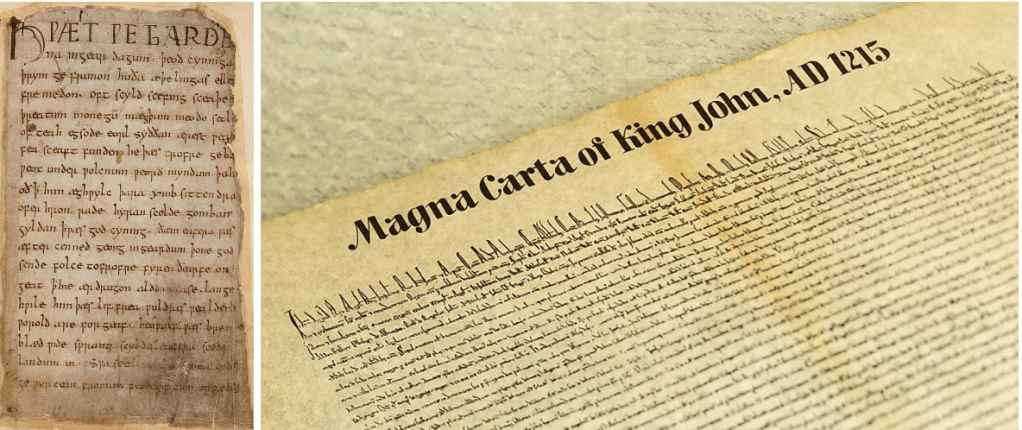
Beowulf, c. 800-1000 AD; The Magna Carta, 1215 AD. 

Clissold made the point that while Shakespearean English from 500yrs ago is largely comprehensible to a secondary student, the epic poem, Beowulf, written in the West Saxon (Germanic) dialect of Olde English approximately 1,000 yrs ago is not. Following the Norman Invasion of 1066, Latin became the language of the courts and the nobility. Both these texts would be incomprehensible to a modern reader of English. https://www.britannica.com/topic/Middle-English-language

However, take this beautiful line from the Tang Dynasty poet, Li Bai. 

“Without a word from the Sky, the four seasons rotate (and thus all things continue to change), and without utterance from the Earth, all life continues to be born, grow and flourish.”

  • Li Bai, c. 750 AD

The wonder and eternity of nature are communicated with an immediacy that is hard to believe given the poet wrote these lines over 1,200yrs ago. And there is a tradition for Chinese politicians to use lines of ancient wisdom within their speeches to connect their thinking to the past. President Xi Jinping used Li Bai’s words in his speech at the December 2020 Climate Ambition Summit. And this can, Clissord attests, be read directly from the original text. https://www.thechinastory.org/the-underappreciation-of-classical-chinese-idioms-xis-climate-speech-1/

When faced with a similar task of translating a line from perhaps the most famous ancient Chinese poet of them all, Du Fu, Y12 TOK students, Tuscany, Henry and Oliver were able to make some meaning and offered a lovely interpretation of a line from an excerpt of Du Fu’s, “On Visiting the Temple of Laozi”, written approx. 750 AD. They explained how the poet observes, “the stitching of the Sun and the Moon on the windows..”

https://en.wikipedia.org/wiki/Du_Fu

The opening to Du Fu’s, “Spring Gaze” was read out by Tim Clissord, and it contains such an evocative opening line as the poet or speaker walks around the ruins of the city after an uprising in Chang’an : 

You can see the work the translator has undertaken to represent the literal meaning of the original, while ensuring both the vocabulary and truncated rhythm of the line capture the starkness of the dramatic situation, and nature’s power to endure. 

Yet, as you can see with this academic website, many translators have tried to emulate Du Fu’s timeless words, but they all interpret the lines subjectively, sometimes with some quite marked differences that can really change the overarching effect of the line. You’ll be able to pick your own favourite interpretation by viewing the selection via the link: https://homepages.ecs.vuw.ac.nz/~ray/ChineseEssays/ChunWang.htm

Yet, it’s not just a matter of choosing the right word to capture the best impression. In the following short video, ICHK Chinese teacher, Jessy Tu, delivers an interpretation of a Chinese nature poem, while making clear the problems of pronunciation in Chinese translation. As we shall see, a change in pronunciation can alter the meaning significantly! 

The plum blossoms are so beautiful I see the fallen leaves lying on the ground with sorrow I hear from afar the sound of a running stream The whole area is full of the green of springtime The riverbank reveals the green-like jadeI have no culture, I have low IQ,If you ask who I am,A fat stupid donkey,I am a donkey,I am a donkey,I am a stupid donkey

Translation on right hand column by Y12 Henry Wang

Ms. Tu preceded her engaging reading with a few core lessons that explain some of the hurdles a new Chinese language learner must face.

Firstly, like English words, one character can have very different meanings, such as the examples below, depending on the context in which they are used in the sentence: 

There’s also the issue faced with an artistic interpretation of an original text by a calligrapher. An excellent actor or artist will add a certain element of colour and distinction to a script or their interpretation of a certain theme or idea. You can visit the Hong Kong Museum of Art to find out more with their current exhibition, “The Melodious Notes of Chinese Calligraphy”, from which the image on the left below is taken:

As with artists such as pianists, painters, singers and poets, calligraphers themselves can interpret the meaning of a text by the creative flourishes of their brush. 

This idea can be explored further when applied to understanding Chinese classical art. The video below is a quick 3-minute masterclass to uncover the craft, uniqueness and value of landscapes by Bruce Maclaren, Global Head of Chinese paintings and calligraphy at Bonhams, who describes the close study of art as an “enlightening” experience.

To return to the fundamentals of language, though, Jessy recommended the Chinese language website, The Silk Story, which provides a good bank of resources that focus on the etymology of the Chinese language and its characters. Take this example for “mouth”- the shape clearly resembles in basic form an open mouth, so the simplistic symbolic depiction of rice paddies, the human form etc within the language makes for an accessible means of unpacking simple words.

https://www.youtube.com/watch?v=CVvIA5aahN8


Many mouths together can indicate a plural but also more to do with tasting as well as quality.

The same variability exists, too, with the character for a person. You can imagine how the first writer in Chinese to decide upon this character saw the figure of a human walking and simplified it to this elegant two-stroke form, before using a stick or flint to etch it into the earliest writing tablets of clay or ox bone. 

Yet, you can also derive the words: people, person, human and human being from the same character. This translation business can get really tricky if you’re trying to just state the obvious, let alone communicate artistic nuance…

So, how can you unlock all this knowledge of ancient languages to win a Nobel Prize? 

Well, that’s exactly what the Chinese scientist Tu Youyou did when she was awarded her prize for research into a cure for malaria in 2015. Her work was actually carried out much earlier, back in the 1970s at the time of the Vietnam War when both the American and Vietnamese militaries were desperate for a cure for malaria. At the time, Clissord stated, American soldiers were dying more from malarial infections than wounds inflicted in the battlefield at a rate as high as 5:1. 

Youyou Tu with Prof Lou Zhicen in the 1950s. She has been working in the China Academy of Chinese Medical Sciences in Beijing for decades, and is now Chief Scientist. Photo: Xinhua

The Americans went all-in on the scientific method and pursued the cure in their laboratories…to no avail. Ho Chi Minh asked the government of Mao Zedong if they could help, and they too used the latest scientific methods, as well as turning their attention back to the hundreds of regional medicine books that had survived across the centuries. Clissord reported a rather stomach-churning cure for leprosy involving eating the scab of a leper. Sounds gross, right? But that process is what we recognise today as vaccination….documented hundreds of years before the “discovery” was accredited by Western scientists to Dr. Edward Jenner for his treatment for smallpox in 1796. https://www.who.int/news-room/spotlight/history-of-vaccination/a-brief-history-of-vaccination

The books of folkloric knowledge studied by Tu Youyou eventually revealed the answer, and she then applied the scientific method to examining the veracity of these ancient traditional herbal remedies. 

And the examples go on… solutions for burst dams that have helped engineers in modern times, as well as naturalistic poetry inspired by the Tao Te Ching which was itself written as early as 200BCE (and which provided many central ideas for my Deep Learning unit: Zen and Sustainability). 

I am very grateful to another of our excellent Chinese teachers at ICHK, Vincent Wang, who replied in a very detailed manner to explain the translation technique which he learned at university and which forms the pedagogical approach for his teaching. The full email reply can be found in the notes at the end of this article, but he writes: 

“During my graduate studies, I took a course called “Translation Studies,” which discussed a Chinese translator from the modern era named Yan Fu. Yan Fu developed a translation theoretical framework known as the “Faithfulness(信), Expressiveness(達), and Elegance(雅)” translation system. “信” refers to faithfully conveying the meaning and information of the original text, ensuring that the translation corresponds to the content of the original.”

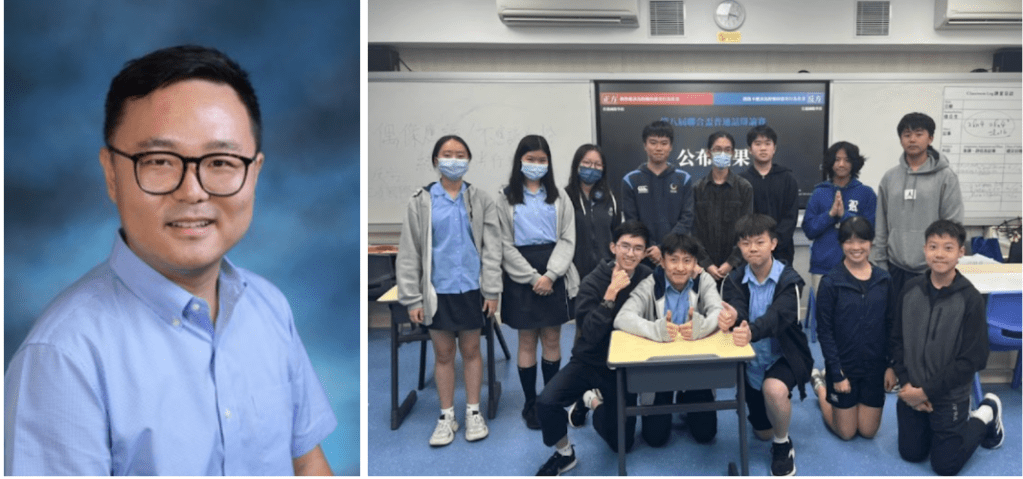
It seems that students in both Ms. Tu’s and Mr Wang’s classrooms are in very good hands indeed- no wonder they’ve performed so well at the recent Debate Competition!

Vincent Wang, and members of his excellent Debate Team

So, will Tim Clissord’s talk propel this “ying guo ren” to buckle down and eventually break through Chapter One of my Chinese language books at home? We shall see, but it was a really enjoyable talk that has made me really want to open my eyes and pay more attention to the world around me for the lessons of culture and history that can be revealed through paying closer attention. 

Other implications for translating Chinese to English

  • Chinese characters can have many meanings, sometimes they are paradoxically contradictory (certainly the English language also shares this problem). There are 7 symbols in lines of Chinese classical poetry, and let’s say there are (at least) three potential meanings for each character, then you have a problem in translating the meaning of this successfully which could be mathematically represented as 3*3*3*3*3*3*3= 2,187 minimum potential interpretations of just one line. 
  • The Chinese language, unlike English, is a null-subject language. This means that it is not possible to determine the subject based on the verb alone, e.g.
  • There are no changes in the tenses, e.g.: Today, I eat vegetables and drink green tea; Yesterday, I eat vegetables and drink green tea; Tomorrow, I eat vegetables and drink green tea etc. 
  • The Lion-Eating Poet in the Stone Den“: The famous example given by Tim Clissold was a nonsense poem written by Yuen Ren Chao featuring tonal variations of the same shi sound…repeated 96 times! 
The Lion-Eating Poet in the Stone Den
https://ninchanese.com/blog/2022/05/09/the-lion-eating-poet-the-meowsome-one-sound-poem-you-can-only-read/


https://www.youtube.com/watch?v=9jtiw721RAg&t=19s

Vincent Wang Email to JR

Hi Jon, 

Thank you for your email. I regret that I won’t be able to attend the lesson, but I have some ideas regarding Chinese translation.

During my graduate studies, I took a course called “Translation Studies,” which discussed a Chinese translator from the modern era named Yan Fu. Yan Fu developed a translation theoretical framework known as the “Faithfulness(信), Expressiveness(達), and Elegance(雅)” translation system. “信” refers to faithfully conveying the meaning and information of the original text, ensuring that the translation corresponds to the content of the original.

“達” refers to the translation’s ability to make the reader understand and resonate with it. In addition to conveying the information from the original text, translation should also adapt to the target language and cultural background. 

“雅” refers to the translation’s need for artistic and aesthetic qualities. Translation should strive for linguistic elegance and fluency while maintaining accuracy and clarity. This requirement is of the highest level and is also the most challenging goal to achieve.

It is interesting to note that there are similarities and overlaps between these perspectives and the theory proposed by a German translation scholar, Reiss, regarding text types. Reiss introduced the theory of text types, which emphasizes the importance of considering the specific characteristics and requirements of different types of texts during the translation process. Later criticisms have emerged suggesting that this translation theory may face challenges due to the inherent difficulty of fully categorizing texts based on their types. 

When I teach the Y9 Kingston Chinese class, I will simply introduce the overlapping aspects of these two theories to help them better understand modern translations of ancient poetry. Reiss proposed that texts can be classified into two main categories: informative texts and expressive texts. When it comes to understanding ancient texts, I usually employ the informative type for teaching purposes. This is because my goal is to quickly convey the meaning of the text to students. Let me provide an example of translation in both Mandarin Chinese and English. For instance, if I want you to understand the term “春節” (chūn jié in Mandarin), I would translate it as “Chinese New Year.” This way, you would grasp the content of the text. This process can be seen as me, acting as a “translator,” building a bridge for students and guiding them across. However, when I teach using the expressive type, I would directly translate it as “Chunjie” and provide subtitles. When I employ the expressive type as the primary method of translation, my intention is to sacrifice the literal content of information transmission and allow students to appreciate the cultural, auditory, and formatting elements behind the text.

Therefore, when it comes to poetry or certain ancient literary texts, if our aim is to help students understand cultural phenomena, I would focus on teaching the format and encourage students to explore the underlying meanings. However, when dealing with non-literary texts, I no longer emphasize cultural elements. That’s why you may see that I allow students to freely express themselves, whether it’s in terms of format or symbols, with the goal of helping them grasp the content.

I saw the translation you provided in the link about the poem translation in Chinese. https://homepages.ecs.vuw.ac.nz/~ray/ChineseEssays/ChunWang.htmYou can see that these translation types are not used independently. The expressive and informative types I mentioned earlier are combined in their usage. In some cases, the focus on conveying meaning may result in the loss of the format and rhythm of ancient Chinese poetry. On the other hand, in some instances, prioritizing the preservation of rhythm may lead to the loss of certain aspects of the content and require readers to explore the underlying meaning of the text. 

The above are some interesting translation theories and ideas that I find useful, especially when teaching ancient Chinese works. I hope you find them helpful as well.

Thank you!

Vincent 

Other Sources:

https://en.wikipedia.org/wiki/Three_Chinese_Poets

https://en.wikipedia.org/wiki/Du_Fu

https://www.maayot.com/blog/chinese-words-with-multiple-meanings/

https://homepages.ecs.vuw.ac.nz/~ray/ChineseEssays/ChunWang.htm

https://www.parliament.uk/magnacarta/
The effect of language on economic behaviour. This paper is relatively recent but has not realy been fully explored and adopted  – link to some questions there. Read the abstract. Thanks to Alex Hall for this link.