- “Humans are adaptable, not optimised,”- Dr. Michael Rivera
- AI can be defined as augmenting productive efficiency
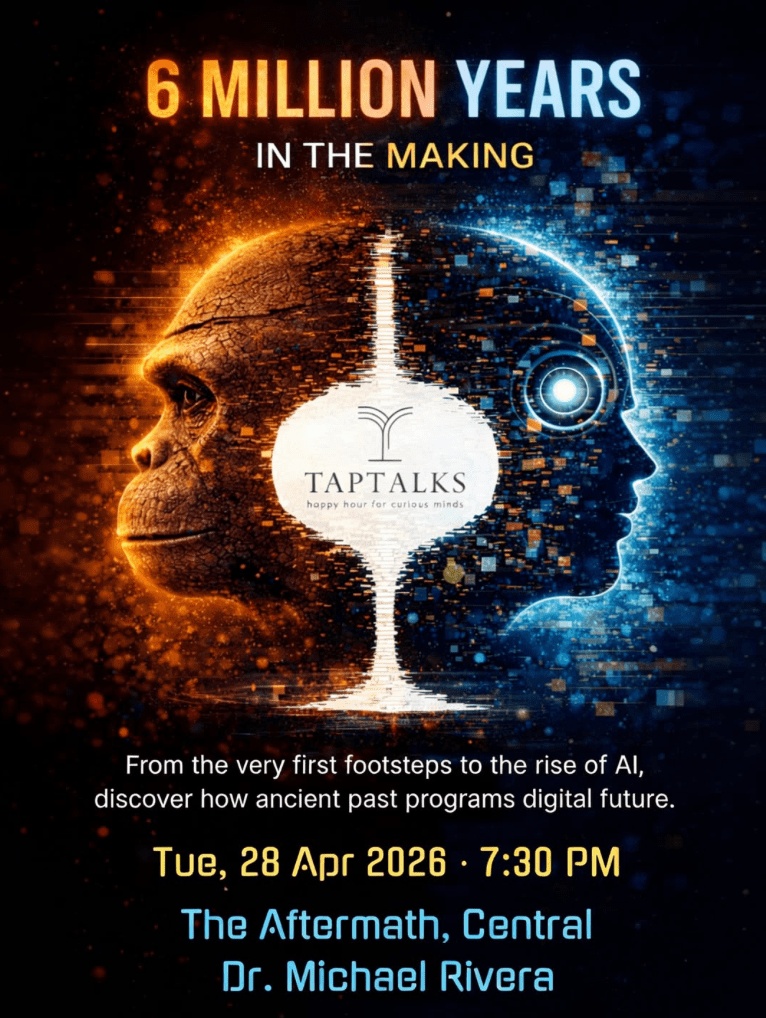
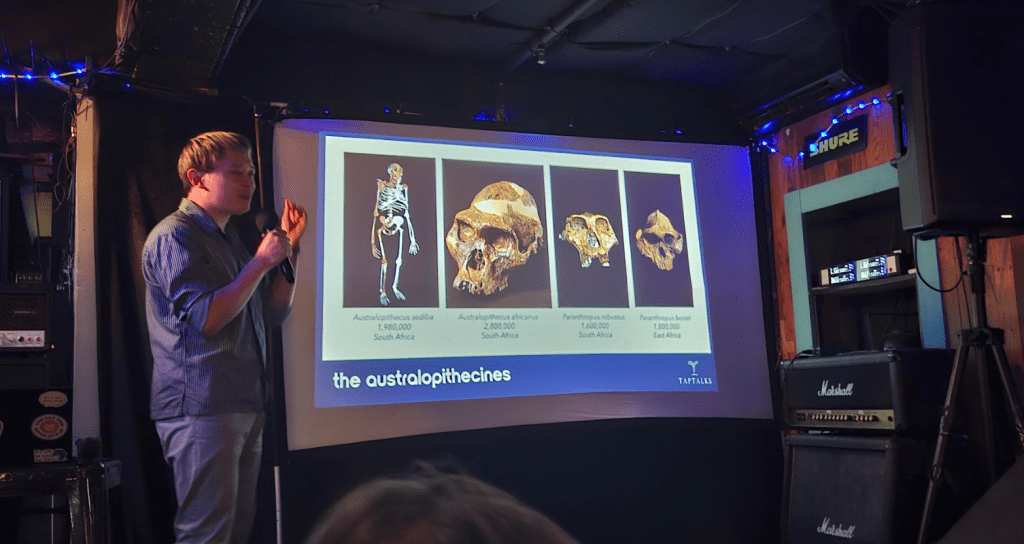
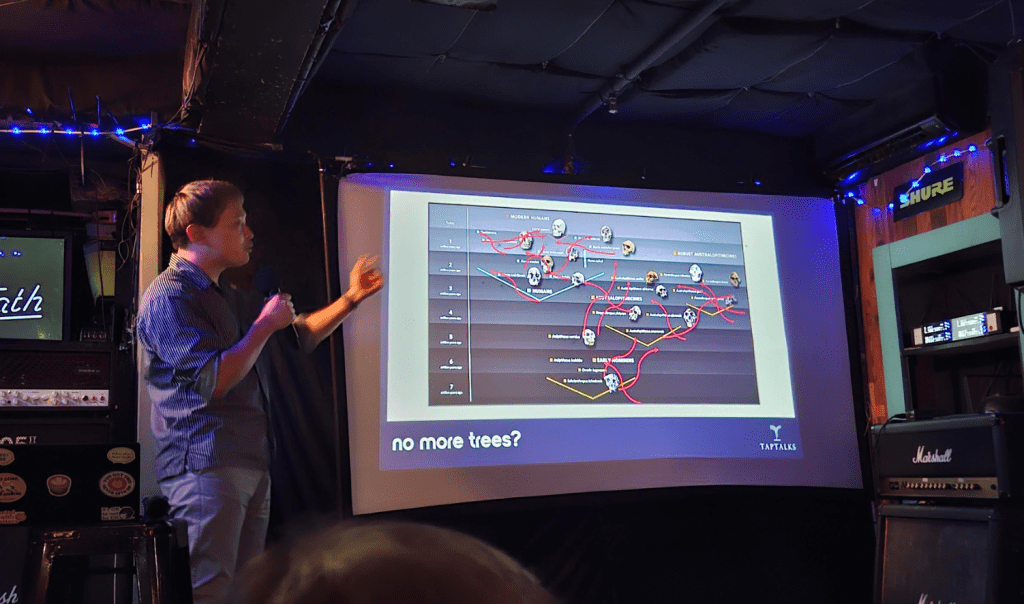
Dr. Michael Rivera, presenter at a Tap Talk event. You can find their events online through their website and social media
As artificial intelligence transforms how we work, think, create, and relate to one another, one question feels more urgent than ever: what exactly does it mean to be human now?
Public conversations about AI often center on fear — fear of replacement, obsolescence, and the erosion of what makes us distinct. But perhaps one of the best ways to think about this moment is not only to look forward, but to look far back.
His goal was to speak passionately and romantically about being human.
- Homosapiens are approximately 300,000yrs old, yet we began our human story 6,000,000yrs ago when we stood on two legs for the first time.
- Rivera is a biological and forensic anthropologist
- He has conducted “beach evolution” studies focused on 4,000 ancient skeletal records here in HK in an attempt to trace our unique evolutionary story. Did the impact of what was available in the food chain have an impact upon our physiology
- One commonality amongst our predecessors is that “they have all become extinct.” That’s quite a cautionary tale, as we now play with godlike technology in the form of AI.
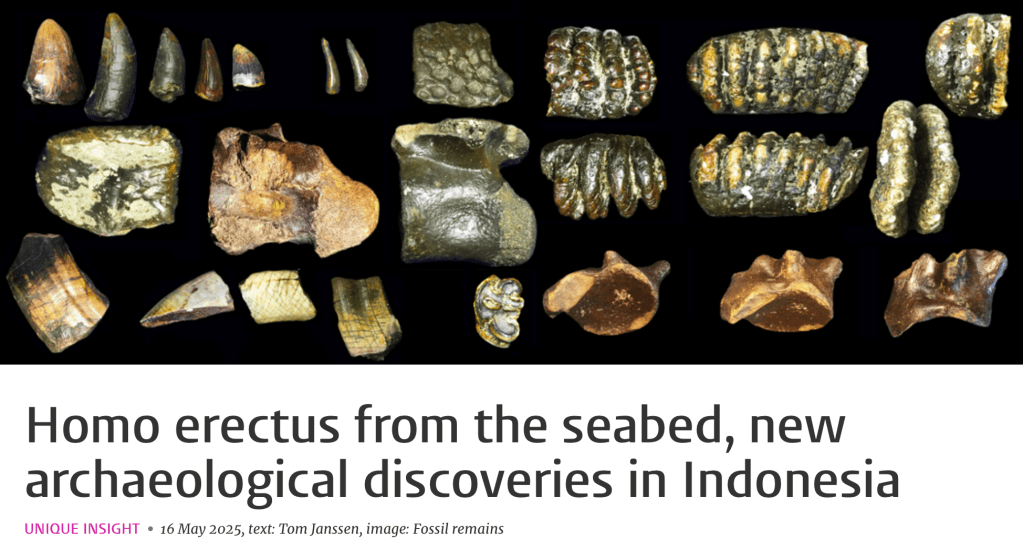
- Homo floresiensis, a hobbit-like precursor to human beings. They only stood about three feet tall and their fossil remains were found in the Liang Bua Cave, on Flores Island, Indonesia. They must have had to learn to adapt to using some impressive strategic hunting and defence strategies given the presence of marauding Komodo dragons!
- https://humanorigins.si.edu/research/asian-research-projects/hobbits-flores-indonesia
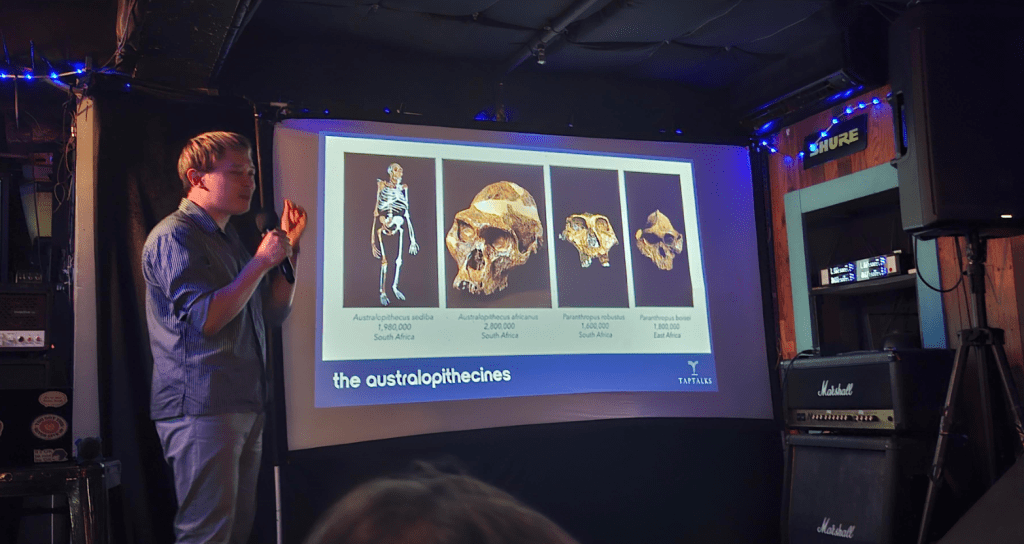
- https://time.com/4126011/lucy-australopithecus-discovery/
- Homo habilis: tool use attributed to this species from over 2,000,000yrs ago. https://www.science.org/content/article/earliest-homo-species-did-not-look-human-partial-skeleton-shows
- https://humanorigins.si.edu/evidence/human-fossils/species/homo-naledi– a massive fossil record from Dinaledi Chamber of the Rising Star Cave system in South Africa during an expedition led by Lee Berger beginning October 2013.
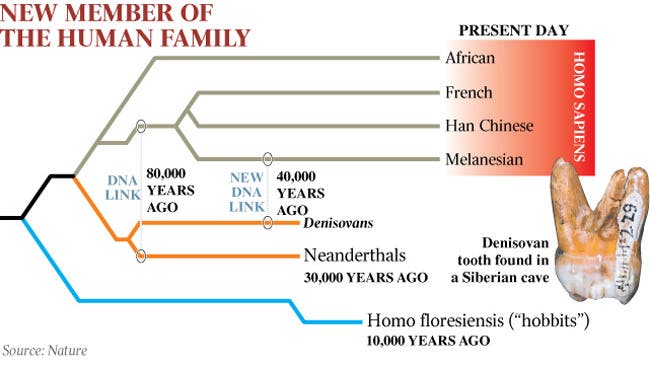
- https://www.arch.ox.ac.uk/denisova-cave– Denisovans bring us much closer to the present day- well, along a timeline composed of millions of years!- as these Siberian ancestors roamed around 300,000 years ago. They ‘had a good innings,’ so to speak as Oxford University researchers traced their bone record to as recently as 49,000 years ago.
- Now, that is a kind of timeline that places them at the same time as Neanderthals! https://www.nhm.ac.uk/discover/who-were-the-neanderthals.html
- You may or may not have heard much about Neanderthals, growing up in this part of the world, as they roamed Western Europe across a timespan that included numerous ice ages. Given the colder climes they occupied, Rivera hypothesised that the reason they were much larger than humans and actually had bigger brains than homosapiens was so that they could adapt to survive these colder conditions.
- And also us! We homospapiens are 300,000yrs old: https://www.nhm.ac.uk/discover/modern-humans-homo-sapiens-when-where-how-did-we-evolve.html
- Modern-day palaeontologists who have mapped the human genome through analysing wide samples of DNA conclude actually have 1-4% of our DNA is Neanderthal!
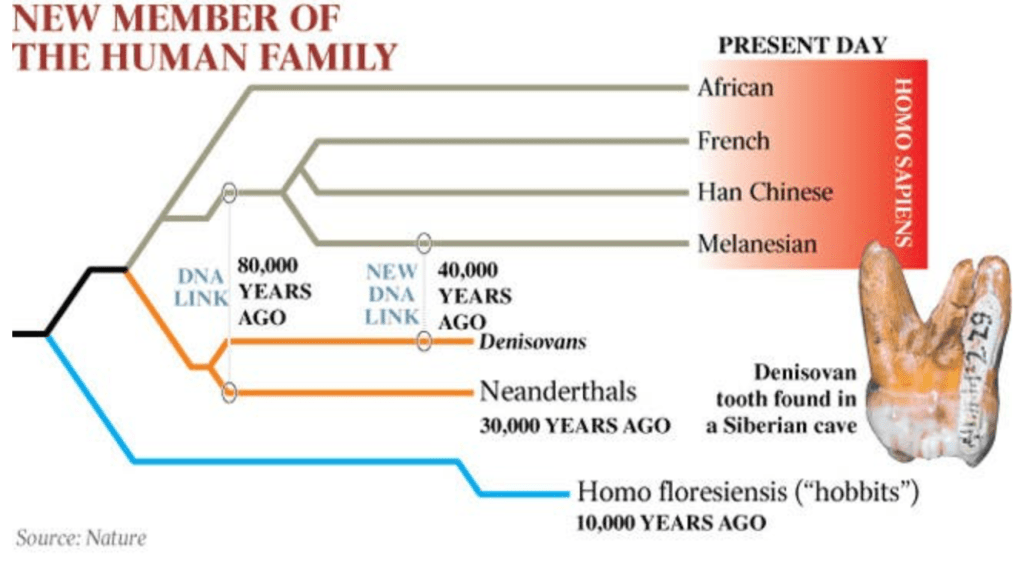
https://cdn.zmescience.com/wp-content/uploads/2012/02/325457-denisovans2.jpg
- And, so, Dr. Rivera concludes that this is one of the limitations of the narrow parameters of our current scientific knowledge paradigm. The Scientific Method is one in which we reduce down and control our variables for experiments so that we can be more accurate in our interpretation of data. It is a rigorous, left-hemisphere, logical, rational, reductive means of classifying and putting objects, species etc. into taxonomies for classification.
- A simple way to show this is the Periodic Table where we have all of our elements organised into solids, gases and liquids.
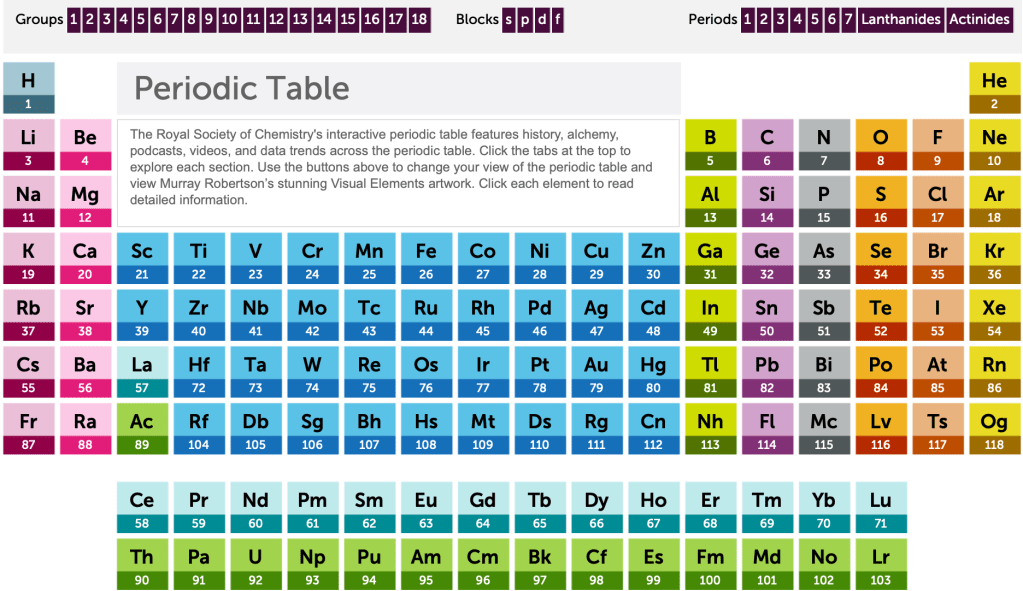
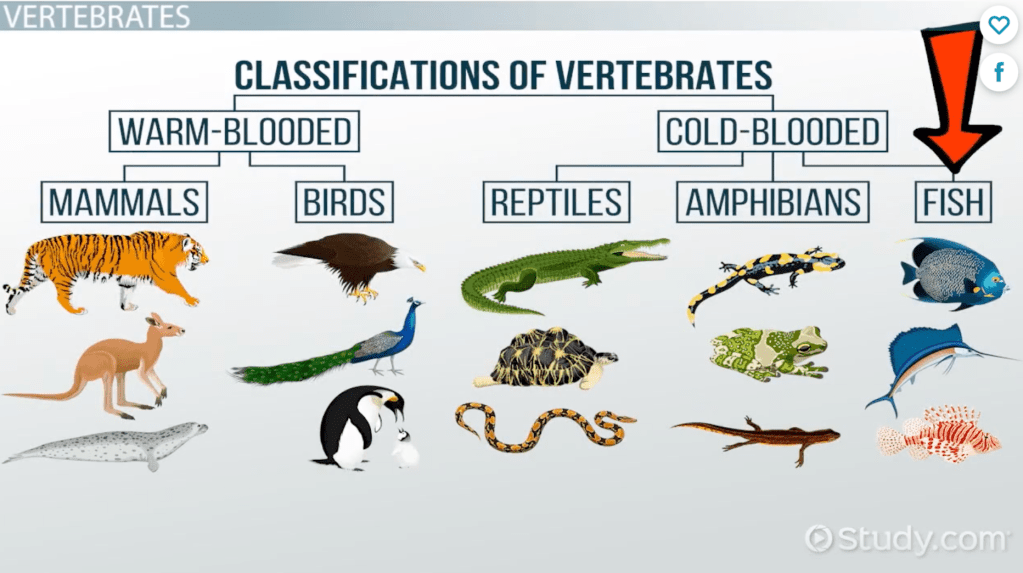
- Of course, there are many useful attributes for sorting species into distinct groups based on commonalities such as whether they are cold-blooded, have gills, or wings, or whatever the Hell a duck-billed platypus is.
- Rivera suggests we might do well to dispense with the term, “species,” even.
- https://www.haaretz.com/archaeology/2025-08-20/ty-article/human-neanderthal-hybrid-child-from-140-000-years-ago-found-in-israels-skhul-cave/00000198-c2ba-dc9d-abd9-dbfec4560000
- The analog (either/or) nature of this thinking has recently been widely discussed in the cultural discussion around gender identity, with many suggesting that the adoption of a sliding scale around identity may be more useful rather than categorising all 8 billion of us either male, or female given the complexity of identity and biology prevalent among us. https://thereader.mitpress.mit.edu/what-evolutionary-biology-can-and-cant-tell-us-about-sex-gender-and-sexuality/
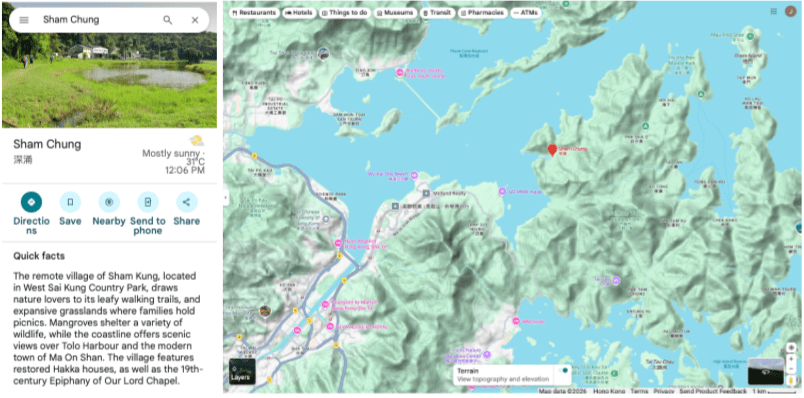
- The 7,000yr-old Wong Tei Tun, is a stone age tool production site located in Sai Kung: https://doaj.org/article/2acbf8dd8ea340688703161f1aabefbd
- “Finding that good media story”
- Cooking and symbolic behaviour
- 140,000yrs ago beads, etchings, shells, signs of cultural communities with artistic sensibilities
- Migration, technology, culture, connection
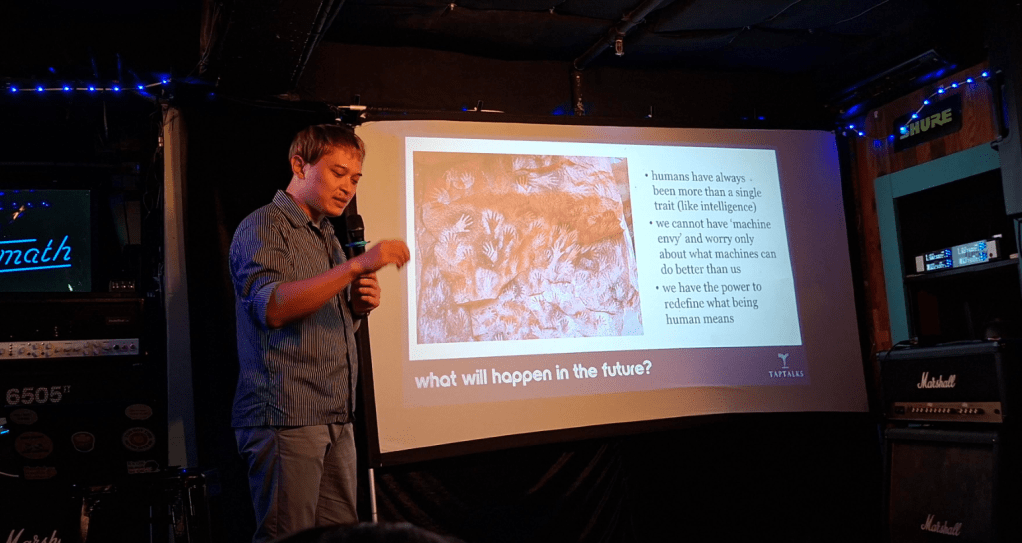
- “Humans are adaptable, not optimised.”
- “Intelligence is more than thinking”
- Embodied experience, sensory intelligence
- Storytelling and meaning making
- Our life experience is non-repeatable
- Cooperation, care, teaching, sharing
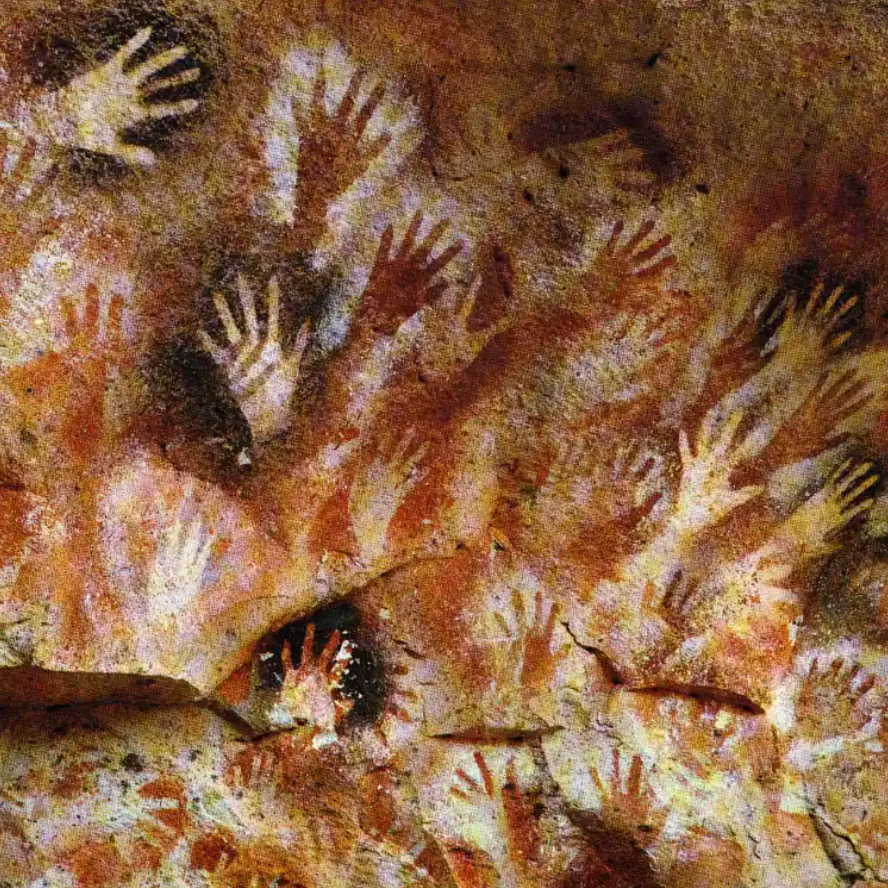
Art: Cave of Hands, Spain, c.13,000-9,500 years ago. Cueva de las Manos, Río Pinturas
The Cueva de las Manos, Río Pinturas, contains an exceptional assemblage of cave art, executed between 13,000 and 9,500 years ago. It takes its name (Cave of the Hands) from the stencilled outlines of human hands in the cave, but there are also many depictions of animals, such as guanacos (Lama guanicoe ), still commonly found in the region, as well as hunting scenes. The people responsible for the paintings may have been the ancestors of the historic hunter-gatherer communities of Patagonia found by European settlers in the 19th century. https://whc.unesco.org/en/list/936/
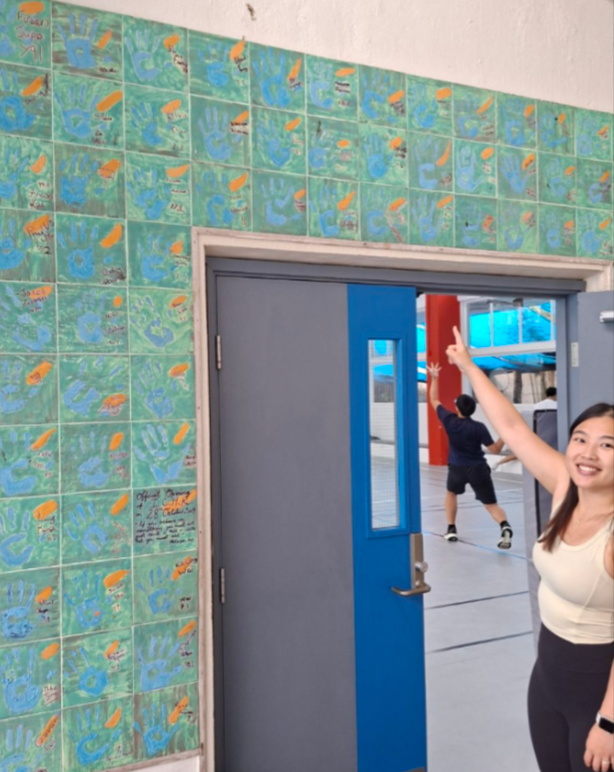
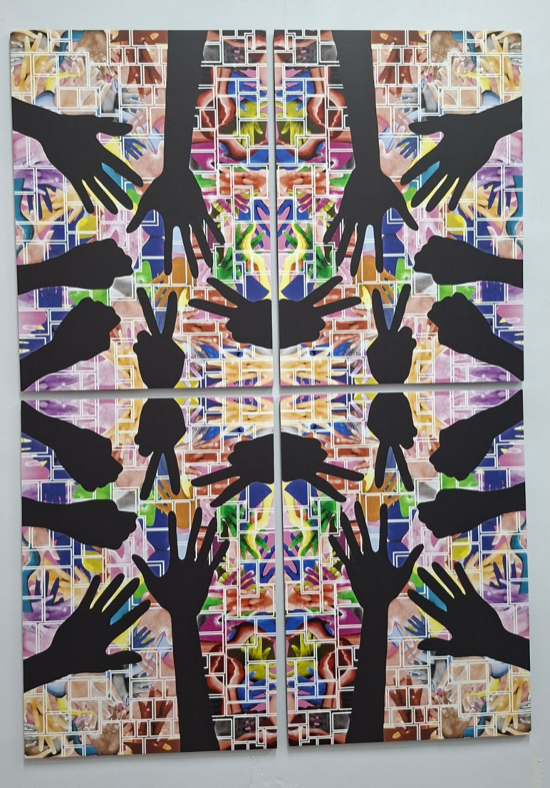
- Digital rewiring of the brain
- Many advantages of the internet on learning
- Essay writing is teaching resilience
- Short cuts means they are too reliant on tech.
- He predicts that we will emerge into a new future where half of society will align to adapting AI; half will turn away and look to cultural connectedness with one another (Romantic mindset)
- We can already see that neurological changes are happening in the brains of our younger generation, and, of course, ourselves.
- Art vs AI: AI’s art is clever and fairly interesting. Rivera describes it as belonging in the “uncanny valley.” Art and artists, though, tell stories of lived experience. Art, experiential learning, drama, music etc. are all the more critical to develop all of our other ways of knowing beyond the quick factfinding and summarising facilities of AI.
- Our human memories, individual and cultural, our traditions and cultures, our capacity for critical thinking, psychological development, creativity are in danger.
- And on top of that there is the environmental depletion that is incurred through the invention and ubiquitous spread of this powerful technology
- To my question, what would you recommend schools do in the face of this AI-age, social atomisation, digital media addiction, “Anxious Generation”? Rivera stated schools should respond with lessons in socialisation and care.
- He is a MindHK advocate who visits 30+ schools and will, depending on what is required, simply teach students “how to have a coffee chat” to develop their social skills.
- “We need each other.”
- Interesting, also, in what he had to say about his skepticism of western-centric nature of knowledge production. He’s also Filipino-Chinese, so, offers them that role model. We assume we are delineated from neanderthals, right? Well, that is true if you are European, but the regional record here in Asia appears to show an intermingling of species that could tell a very different story. He is also skeptical of recent attempts to provide a more ‘international’ (his air quotes!) survey of “100,000 genomes around the world”, from the Human Genome Project; yet there are thousands from Germany, but only 2 samples from Ghana, for example. He is following the work of the Asian Genome Project closely, as they look at address some of the western-centric biases built-into the body of scientific knowledge.
 Sustainability, Human Technologies and Theory of Knowledge