Photography and Walking

Year 7-9 Flexible Learning Projects, ICHK Secondary

Please can students take note that any outdoor activity requires the full permission of parents. We advise you to wear a facemask at any point where you might come into contact with others. Please exercise a cautious mindset in-line with those the current conditions require.

Timeframe1hr: Urban/Waterfront2hrs + Hiking/Nature, but hopefully a hobby/habit you can get into for much longer than that….Groupings: Individual/Pairs/GroupMajorsArts, Digital Media Literacy
Minors: Mindfulness
Blurb: Through indulging in some gentle or more rigorous exercise, you can get some fresh air, and, through using a keen eye, LOOK CLOSELY at your local area for photographic inspiration. 
The photographs used as examples in this unit are based on my experiences walking away from crowds down to local parks, waterfront walkways and hiking trails, well away from crowds. You can just enjoy being in contact with nature. You can also use the photos to “footnote” your journeys so that you can organise future trips more easily/share ideas with others.
If you take any kind of smartphone or camera with you, you can turn this physical activity into a creative, artistic one by challenging yourself to compose a series of images which document your local landscape, and/or the beauty of Hong Kong’s amazing natural escapes…!
OutcomesA portfolio of 24 images which showcase your inventive use of camera shots:
Rule of threeSymmetryZOOMING INZooming OUTContrast
NB: I am only a very amateur photographer and have very little technical knowledge of photography. This is just a very basic introduction to the subject, which, if you enjoy, you can study much more intently down-the-line!
Getting HelpIf you are stuck, please email submissions@ichk.edu.hk for help, and a teacher will respond as soon as possible. If you need instant help, please call the school reception (2655 9018) and ask to speak to a member of the Senior Leadership Team.Optionally, email jrees@ichk.edu.hk for help

Content

Prepare for your walk:

Make sure you have what you need. Be mindful and think about taking care of yourself.

Here are a few ideas to use as a checklist:

Water bottle, clothes in case it rains, sun screen, bug spray, money, octopus card, phone, camera, anything you need for the activity itself. 

Be safe- tell someone where you are going and have a plan in case you get lost or something goes wrong.

Safety Plan:

  • Stop, Breathe, Think.
  • Work out where you think you are- look at landmarks, shop names, signposts, MTR stops, footpath signs.
  • Work out how to get in touch with your emergency contact.
  • Use a different contact if that does not work- friend, police officer, transport worker, shop worker.

Activity

“I want to encourage you to think back to the days when people had to get by on the 24 or 36 roll of film in their cameras…

They couldn’t constantly click thousands of photos. Nor do you want to have the hassle of sifting through a load of junk for the Instagram photos you eventually choose to upload. 

There’s no hurry here, either. For this activity, you’re walking in parks, down near the harbour, or in the national parks. Basically, unless an interesting creature jumps out- you won’t need to hustle to capture it!

When I walk, I like to look around my surroundings. Sometimes I walk slowly to take in the scene. I love to “people watch” too and see all walks of life heading out to work, enjoying a leisurely stroll themselves, parents or helpers playing with children, the care and attention a flower seller takes to arrange their shop front, older folk engaged in tai-chi… 

You can tap into the spirit of a place by observing people going about their days far better than visiting a museum.

Sometimes I walk fast for exercise. Being fit allows you the ability to walk further…to see and experience more vistas. When I hiked the 50km Hong Kong Trail, I took about 30 pictures in total. That’s quite a lot, I guess, but over 9hrs, and all those kilometres, maybe not so much. That gives you a sense of the frequency anyway- just try to take pictures of the scenes that you know are special. 

But walking slowly has its merits too. And now I have injured my hamstring, that is what I am having to do..! Even if it means for some precious minutes escaping the bright lights of your computer screen, you can get outside and go for a walk. It’s nice to do this by yourself sometimes, but it’s also really nice to do it with a group on occasion. Why don’t you see if a friend/friends wants to join you? 

Slow. Things. Down. 

Your mind will respond to the calmness of the rhythm of your slower stride. And by taking things that much slower, you are likely to be able to admire things you might have missed, even if you had been walking down those streets a thousand times before. 

By exercising discretion, and pausing to think about the shot, before you even take the camera out of your pocket, you will definitely take better pictures. But, also, by thinking along these lines, you can allow yourself to be more present in the moment…

As you enjoy the experience of walking and observing your area first and foremost- suddenly, a particularly arresting moment will present itself- then, SNAP!- you can capture that image and return to your peaceful state of mind, with your camera back in your pocket. 

I will divide the next part of this tutorial into three sections: Nature/Hiking; Waterfront; Urban. All photos were taken with my Samsung phone and there are those that might say- “that shows!” I’m not saying they’re great, but I do think some are pretty interesting, and they are ones that I might enjoy looking at in years to come. 

Finally, by taking photos and publishing to a real audience- which is what you are doing when you choose to write, post anything to Facebook/Instagram/Insight magazine etc.-, you are taking the first very important steps for communicating something about yourself to the world. It is the start of a process of self-discovery and self-confidence, and fomenting these dispositions of mind-set will help you so much down-the-line in fields far removed from photography…!

Nature/Hiking

Cows: Was there ever a subject so docile and placid than a Hong Kong feral cow? I did take about four photos of this chap, on the approach to the Macelhose Trail 1/2 at the Eastern dam- just had to wait for him to look up! But those volcanic islands in the background are like nothing I see back in the UK, and the presence of this little fella adds a bit of personality to a regular landscape shot.

Images of pathways are pretty easy go-to literary tropes. Photos of your hikes can be stories that you share with others. I have gotten into the habit of “footnoting” hikes with special views but also to jog my memory for when I undertake similar hikes in the future. This is a view of the striking mountain range ahead with the path angling off into the distance, while I have tried to use the plants to provide some sort of frame to the shot and to give a sense of depth. 

In Hong Kong, sometimes the light just does magical things. I’ve no idea really how/why (maybe it is the sun that breaks out from behind the cloud, or the angle of the sun at certain times of day- this was towards dusk- but pretty much the same flora/fauna acquire a beautiful sheen and the varieties of greens can add a lot of contrast to the photos. I try to follow the rules of thirds by placing the paths diagonally rather than square on which could be discomforting and reduce the calm atmosphere.

Long-distance landscapes: This is from the top of the ascent from the very start of Maclehose 3- it’s a very steep 400m rise up from the road! Again, Hong Kong’s natural landscapes are just magnificent. The volcanoes extend into the distance and you can see Sai Kung there just on the right. 

Hiking gets you out to explore a wide range of new areas in the city. This is a view of Kowloon and Hong Kong from the Wilson Trail 2/3. It’s a little hazy, and I regret that the ugly, rusty, metal rail is there- should have stepped forward- but it’s the “biggest” view of the city I’ve seen. Those closer-up views of HK skyscrapers from the Peak are amazing, but I love the sense of sprawl, despite the hazy day.

Colour/texture contrast: I think this is my favourite photo of a landscape I’ve taken, and, as usual, Hong Kong has done all the work. You simply have to get out there on the trails. We live in a uniquely beautiful place and the more you can get out and enjoy it, the better! The late afternoon light just before dusk seems to have a wonderful, soft golden glow to it. It adds a depth of colour to the spectrum of plant life from the golden bullrushes which bend with the breeze towards the green mountains beyond. Man, where he does intrude, even looks quite pretty with Stanley seen from a distance on the Dragon’s Back Trail.  

Another one of those weird times of day/angles of the sun where the light does the work for you and there are all these interesting contrasts in textures, colours and perspectives between the types of vegetation such as the bullrush grass, hardy evergreens, the granite boulders, and the sea and mountains in the distance. This is from the ascent to Tai Mo Shan, Hong Kong’s highest peak at 957m, from the Macelhose Trail Section 7 to 8.

Framing: A view back to the city. We almost missed this amazing view of HK Island , had not Mr. McDermott turned back and alerted us. I’ve tried to use the windswept tree branches as some sort of jungly framing device, and the contrast of the jungle and nature in the foreground, which dominates, and reduces the IFC- the sum of all man’s arrogant conceits!- to a tiny focal point in the centre, lower third.

Using natural elements to frame the photo. Early morning and after 3pm till dusk seem to be the best time to take photos of natural landscapes here in Hong Kong. This is the Hong Kong trail section 8, I think, winding down towards Shek O before you double back and up onto the Dragon’s Back Trail, ending in Big Wave Bay.

Urban:

The same subject from a different perspective. New Year 2020: this photo was taken from the way back down from High West, Hong Kong Island. It would definitely look much nicer with a better camera, but, luckily, coming to my aid that night was the massive “Wolf Moon” that occurred during early January. The ICC is proclaiming the new year and the IFC seems to be beaming its light up directly at the moon, but the moon was so bright that night that it really resonated even against the competition of all that man-made neon light below. 

The view from High West on the same hike earlier that evening. 

This is one of those days, such as right now, when the factories in Mainland China have shut down (then it was for Chinese New Year, now it is due to the coronavirus) and the views go on for miles. Lantau is visible in the background to this shot from Macelhose 6 walking north through the Kowloon Reservoir system. The powerlines act to dissect the shot horizontally into thirds. Hong Kong looked like a little toytown the way the buildings were so neatly stacked and the air was so crisp and clear. 

Trying to find the old Hong Kong might be increasingly difficult as the glass and steel skyscrapers dominate, but there are pockets of ancient ways all around. This is the Tin Hau Temple, at, well Tin Hau. My phone camera definitely doesn’t do justice to the temple as a whole, but you can then Zoom-in to key features which give the sense of the place. In the first picture, I made sure I left in the column to frame, as well as the Cantones script, while the main focus is the beautiful paper lantern with tiger design, while the ceremonial doors and wooden awning frame the rest of the photo at an angle. You could do a whole photo series of those miniature shrines that appear in the foot of residential/shop doorways all over the city…!

Waterfront: 

A fisherman at dusk. I like the balance between the natural sea and the man-made aspects of the buildings and the jetty. The wooden planks they have used for the materials of the waterfront park are very soft and naturalistic too. The planks form “vanishing point” to the sun in the distance. I didn’t notice this at the time, but I was trying to use the fishing rods to provide symmetry. Of course the light at sundown on a clear day is beautiful, so, it’s always worth keeping an eye on https://aqicn.org/city/hongkong/. If it’s green then GO!; if it’s yellow, then, well, maybe. To be honest, with photography, you can probably get some pretty cool effects if it’s pretty hazy too..!

In recent months, the Hong Kong Government have opened up huge waterfront spaces that allow you to access nature easily from your home. This is wonderful. You can avoid crowds and enjoy some fresh air the whole way down from Wan Chai Convention Centre to Kennedy Town now. This route takes you part of the way through a working industrial shipyard,which is fascinating; Hong Kongers have have cottoned on to the very Instagram-able nature of these tough, rough angular backdrops. 

The rusty, old coal barge in this photo is meant to be providing both a frame for the view in the background, as well as the contrast between the rough, red, ionised metal and the softer blue sky in the background. If you were to Zoom in, there’s someone walking with an umbrella on the pier in the distance- It doesn’t quite work given perspective , but I do think that if you spend time thinking critically about your compositions while working with just your phone, you can think about whether it is worth buying a proper camera down-the-line. 

Not a particularly beautiful photo, but I do love the reclaimed industrial space for pedestrians to enjoy. I’m all for any move the Hong Kong Gov’t makes to make the city more sustainable and the greening of formerly industrial spaces, and installation of exercise equipment for the older folk to enjoy is lovely. I think if you are photographing people then you really need to be polite and ask their permission, but I hope I’m far enough away here not to intrude in their personal space, plus, it’s anonymous as they are faced looking away and the main focus of this photo is Victoria Harbour, as well as the crane which has been incorporated into part of the urban park and play area for children. The “vanishing lines” of the shadow also appear to point towards the ICC on the other side of the harbour, but that is totally coincidental. 

Even the mundane can become interesting if you are able to compose the frame to pick out some interesting angles and colour combinations. This is a photo of two coal barges at anchor together in the harbour with the multi-coloured barrels making it look like some kind of playground and the distinctive Hong Kong English and Cantonese scripts “anchoring” this photo distinctly in Hong Kong. 

Same subject, different angle: The final thought to leave you with is a sequence of images I took of a ship coming into harbour. I didn’t know it was coming into harbour, but I saw it moving against the backdrop of the descending sun. Even a smoke-belching, rust-riddled old ship- with tons of character and tales from all the oceans it has traversed- has its own beaten-up beauty! As the ship came in closer-and-closer, there was a flurry of activity from photographers looking out to the bay. As I changed my angle the colour of the sea, changed from shimmering golden reflections of the sun, to ultramarine, and a dark, deep steel blue. The ship moving in meant I could look at it from different angles and let it dominate the frame from a low-angle, close-up shot. Then, as I walked along further, i just happened to notice these lovely hand-knitted puppets that some artist/artists had installed to help beautify the spot. They provided the audience for the final couple of shots as the ship pulled out of harbour and out, once more, to the vastness of the South China Sea…!

The Chinese Written Language and its Capacity to Communicate Wisdom across the Centuries…

…and the Challenges Faced in Translation 

Tim Clissold shows how the unchanging nature of the Chinese written word connects the past to the present in ways that do not exist in the West.  This connection helped a Chinese scientist to win the 2015 Nobel Prize for medicine.  It is also used in present day economics.

But Tim argues that the greatest lessons for many come from poems written more than 1,000 years ago, that deal with problems that are all too familiar in modern times.  These include the plight of refugees, social inequality, homelessness, tax evasion, substance abuse and even the perils of excessive logging. 

What, he asks, can mankind learn from these lines as they echo down the centuries? 

Royal Geographic Society infomercial

==================================================================

The ideas in this feature article are often taken directly from a Royal Geographic Society talk I attended in November, entitled, “Ancient Words for the Modern Age” by the author Tim Clissold who has lived and worked in China for over thirty years. He’s written a number of books about his experiences, including Mr. China, Chinese Rules, and his most recent work, Cloud Chamber. I’ve tried to give credit as clearly as I can to where an idea was introduced by the presenter. 

The talk was inspired by what Tim Clissold identified as the Chinese written language’s capacity to pass down wisdom in the fields of engineering, medicine, poetry and philosophy across millennia due to the comparative constancy of its characters (as opposed to, say, the English language). 

He discussed how he fell in love with Chinese culture and language when he first arrived in Hong Kong and was fascinated by its beautiful stylised calligraphic form; but how, he wondered, could he ever penetrate the complexity of a language that featured, for example, the 26-stroke character that is the first of the two character word for “Wan Chai”?

Wan Chai MTR Station: the emotive flourishes of Chinese calligraphy first captured Clissold’s interest

I’m also extremely grateful to our Chinese language teachers, Vincent Wang and Jessy Tu, who were very generous with their ideas and time to help me support my classes with a range of clear examples. They were able to add colour and depth with some excellent insights into the challenges/methods that a language learner faces and utilises when translating Chinese into English in fun and exciting ways. These dual themes of the propensity for the Chinese language to communicate wisdom, and the challenges of “taking the language out of its original context” (to refer to a May 2024 TOK Essay Title), were the dual themes of Clissold’s talk and this article.

I hope this article may provide some motivation for those, like me, who have struggled to learn Cantonese or Mandarin by approaching it from a more visual and poetic standpoint, as well as providing some interesting cultural and historical perspectives on the language.

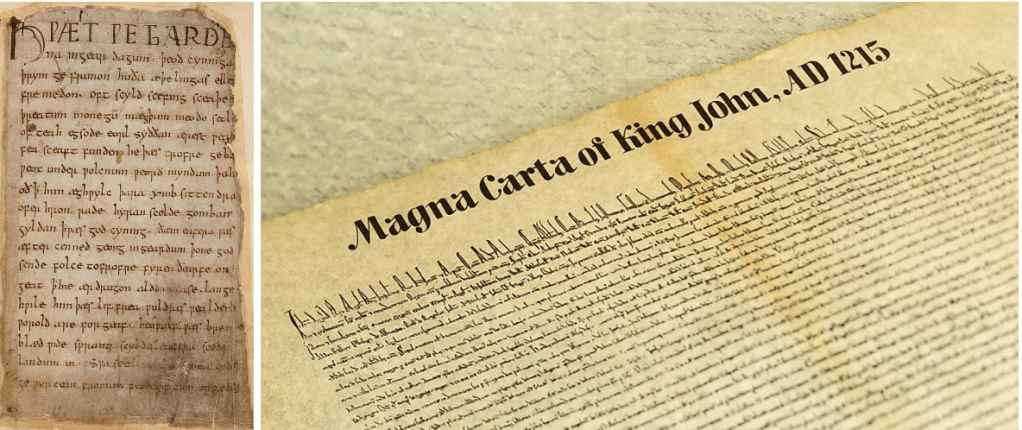
Beowulf, c. 800-1000 AD; The Magna Carta, 1215 AD. 

Clissold made the point that while Shakespearean English from 500yrs ago is largely comprehensible to a secondary student, the epic poem, Beowulf, written in the West Saxon (Germanic) dialect of Olde English approximately 1,000 yrs ago is not. Following the Norman Invasion of 1066, Latin became the language of the courts and the nobility. Both these texts would be incomprehensible to a modern reader of English. https://www.britannica.com/topic/Middle-English-language

However, take this beautiful line from the Tang Dynasty poet, Li Bai. 

“Without a word from the Sky, the four seasons rotate (and thus all things continue to change), and without utterance from the Earth, all life continues to be born, grow and flourish.”

  • Li Bai, c. 750 AD

The wonder and eternity of nature are communicated with an immediacy that is hard to believe given the poet wrote these lines over 1,200yrs ago. And there is a tradition for Chinese politicians to use lines of ancient wisdom within their speeches to connect their thinking to the past. President Xi Jinping used Li Bai’s words in his speech at the December 2020 Climate Ambition Summit. And this can, Clissord attests, be read directly from the original text. https://www.thechinastory.org/the-underappreciation-of-classical-chinese-idioms-xis-climate-speech-1/

When faced with a similar task of translating a line from perhaps the most famous ancient Chinese poet of them all, Du Fu, Y12 TOK students, Tuscany, Henry and Oliver were able to make some meaning and offered a lovely interpretation of a line from an excerpt of Du Fu’s, “On Visiting the Temple of Laozi”, written approx. 750 AD. They explained how the poet observes, “the stitching of the Sun and the Moon on the windows..”

https://en.wikipedia.org/wiki/Du_Fu

The opening to Du Fu’s, “Spring Gaze” was read out by Tim Clissord, and it contains such an evocative opening line as the poet or speaker walks around the ruins of the city after an uprising in Chang’an : 

You can see the work the translator has undertaken to represent the literal meaning of the original, while ensuring both the vocabulary and truncated rhythm of the line capture the starkness of the dramatic situation, and nature’s power to endure. 

Yet, as you can see with this academic website, many translators have tried to emulate Du Fu’s timeless words, but they all interpret the lines subjectively, sometimes with some quite marked differences that can really change the overarching effect of the line. You’ll be able to pick your own favourite interpretation by viewing the selection via the link: https://homepages.ecs.vuw.ac.nz/~ray/ChineseEssays/ChunWang.htm

Yet, it’s not just a matter of choosing the right word to capture the best impression. In the following short video, ICHK Chinese teacher, Jessy Tu, delivers an interpretation of a Chinese nature poem, while making clear the problems of pronunciation in Chinese translation. As we shall see, a change in pronunciation can alter the meaning significantly! 

The plum blossoms are so beautiful I see the fallen leaves lying on the ground with sorrow I hear from afar the sound of a running stream The whole area is full of the green of springtime The riverbank reveals the green-like jadeI have no culture, I have low IQ,If you ask who I am,A fat stupid donkey,I am a donkey,I am a donkey,I am a stupid donkey

Translation on right hand column by Y12 Henry Wang

Ms. Tu preceded her engaging reading with a few core lessons that explain some of the hurdles a new Chinese language learner must face.

Firstly, like English words, one character can have very different meanings, such as the examples below, depending on the context in which they are used in the sentence: 

There’s also the issue faced with an artistic interpretation of an original text by a calligrapher. An excellent actor or artist will add a certain element of colour and distinction to a script or their interpretation of a certain theme or idea. You can visit the Hong Kong Museum of Art to find out more with their current exhibition, “The Melodious Notes of Chinese Calligraphy”, from which the image on the left below is taken:

As with artists such as pianists, painters, singers and poets, calligraphers themselves can interpret the meaning of a text by the creative flourishes of their brush. 

This idea can be explored further when applied to understanding Chinese classical art. The video below is a quick 3-minute masterclass to uncover the craft, uniqueness and value of landscapes by Bruce Maclaren, Global Head of Chinese paintings and calligraphy at Bonhams, who describes the close study of art as an “enlightening” experience.

To return to the fundamentals of language, though, Jessy recommended the Chinese language website, The Silk Story, which provides a good bank of resources that focus on the etymology of the Chinese language and its characters. Take this example for “mouth”- the shape clearly resembles in basic form an open mouth, so the simplistic symbolic depiction of rice paddies, the human form etc within the language makes for an accessible means of unpacking simple words.

https://www.youtube.com/watch?v=CVvIA5aahN8


Many mouths together can indicate a plural but also more to do with tasting as well as quality.

The same variability exists, too, with the character for a person. You can imagine how the first writer in Chinese to decide upon this character saw the figure of a human walking and simplified it to this elegant two-stroke form, before using a stick or flint to etch it into the earliest writing tablets of clay or ox bone. 

Yet, you can also derive the words: people, person, human and human being from the same character. This translation business can get really tricky if you’re trying to just state the obvious, let alone communicate artistic nuance…

So, how can you unlock all this knowledge of ancient languages to win a Nobel Prize? 

Well, that’s exactly what the Chinese scientist Tu Youyou did when she was awarded her prize for research into a cure for malaria in 2015. Her work was actually carried out much earlier, back in the 1970s at the time of the Vietnam War when both the American and Vietnamese militaries were desperate for a cure for malaria. At the time, Clissord stated, American soldiers were dying more from malarial infections than wounds inflicted in the battlefield at a rate as high as 5:1. 

Youyou Tu with Prof Lou Zhicen in the 1950s. She has been working in the China Academy of Chinese Medical Sciences in Beijing for decades, and is now Chief Scientist. Photo: Xinhua

The Americans went all-in on the scientific method and pursued the cure in their laboratories…to no avail. Ho Chi Minh asked the government of Mao Zedong if they could help, and they too used the latest scientific methods, as well as turning their attention back to the hundreds of regional medicine books that had survived across the centuries. Clissord reported a rather stomach-churning cure for leprosy involving eating the scab of a leper. Sounds gross, right? But that process is what we recognise today as vaccination….documented hundreds of years before the “discovery” was accredited by Western scientists to Dr. Edward Jenner for his treatment for smallpox in 1796. https://www.who.int/news-room/spotlight/history-of-vaccination/a-brief-history-of-vaccination

The books of folkloric knowledge studied by Tu Youyou eventually revealed the answer, and she then applied the scientific method to examining the veracity of these ancient traditional herbal remedies. 

And the examples go on… solutions for burst dams that have helped engineers in modern times, as well as naturalistic poetry inspired by the Tao Te Ching which was itself written as early as 200BCE (and which provided many central ideas for my Deep Learning unit: Zen and Sustainability). 

I am very grateful to another of our excellent Chinese teachers at ICHK, Vincent Wang, who replied in a very detailed manner to explain the translation technique which he learned at university and which forms the pedagogical approach for his teaching. The full email reply can be found in the notes at the end of this article, but he writes: 

“During my graduate studies, I took a course called “Translation Studies,” which discussed a Chinese translator from the modern era named Yan Fu. Yan Fu developed a translation theoretical framework known as the “Faithfulness(信), Expressiveness(達), and Elegance(雅)” translation system. “信” refers to faithfully conveying the meaning and information of the original text, ensuring that the translation corresponds to the content of the original.”

It seems that students in both Ms. Tu’s and Mr Wang’s classrooms are in very good hands indeed- no wonder they’ve performed so well at the recent Debate Competition!

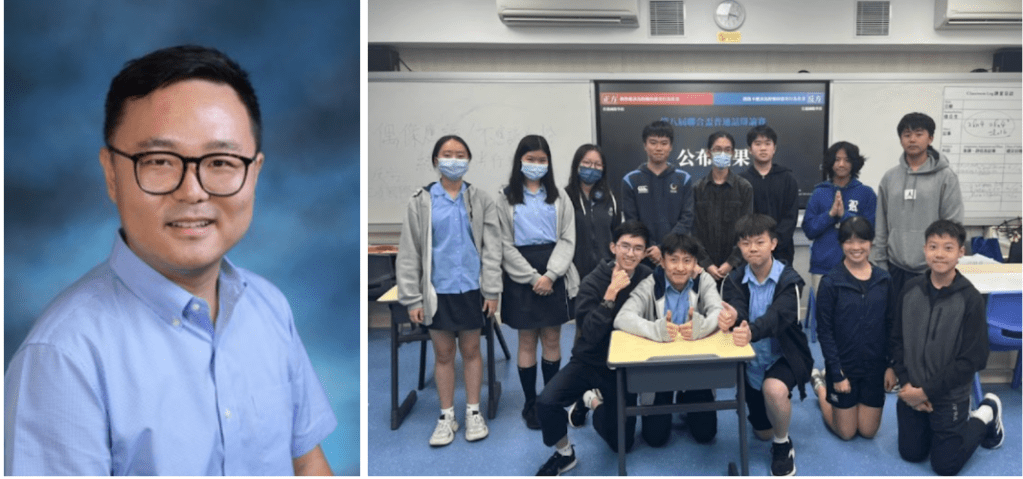
Vincent Wang, and members of his excellent Debate Team

So, will Tim Clissord’s talk propel this “ying guo ren” to buckle down and eventually break through Chapter One of my Chinese language books at home? We shall see, but it was a really enjoyable talk that has made me really want to open my eyes and pay more attention to the world around me for the lessons of culture and history that can be revealed through paying closer attention. 

Other implications for translating Chinese to English

  • Chinese characters can have many meanings, sometimes they are paradoxically contradictory (certainly the English language also shares this problem). There are 7 symbols in lines of Chinese classical poetry, and let’s say there are (at least) three potential meanings for each character, then you have a problem in translating the meaning of this successfully which could be mathematically represented as 3*3*3*3*3*3*3= 2,187 minimum potential interpretations of just one line. 
  • The Chinese language, unlike English, is a null-subject language. This means that it is not possible to determine the subject based on the verb alone, e.g.
  • There are no changes in the tenses, e.g.: Today, I eat vegetables and drink green tea; Yesterday, I eat vegetables and drink green tea; Tomorrow, I eat vegetables and drink green tea etc. 
  • The Lion-Eating Poet in the Stone Den“: The famous example given by Tim Clissold was a nonsense poem written by Yuen Ren Chao featuring tonal variations of the same shi sound…repeated 96 times! 
The Lion-Eating Poet in the Stone Den
https://ninchanese.com/blog/2022/05/09/the-lion-eating-poet-the-meowsome-one-sound-poem-you-can-only-read/


https://www.youtube.com/watch?v=9jtiw721RAg&t=19s

Vincent Wang Email to JR

Hi Jon, 

Thank you for your email. I regret that I won’t be able to attend the lesson, but I have some ideas regarding Chinese translation.

During my graduate studies, I took a course called “Translation Studies,” which discussed a Chinese translator from the modern era named Yan Fu. Yan Fu developed a translation theoretical framework known as the “Faithfulness(信), Expressiveness(達), and Elegance(雅)” translation system. “信” refers to faithfully conveying the meaning and information of the original text, ensuring that the translation corresponds to the content of the original.

“達” refers to the translation’s ability to make the reader understand and resonate with it. In addition to conveying the information from the original text, translation should also adapt to the target language and cultural background. 

“雅” refers to the translation’s need for artistic and aesthetic qualities. Translation should strive for linguistic elegance and fluency while maintaining accuracy and clarity. This requirement is of the highest level and is also the most challenging goal to achieve.

It is interesting to note that there are similarities and overlaps between these perspectives and the theory proposed by a German translation scholar, Reiss, regarding text types. Reiss introduced the theory of text types, which emphasizes the importance of considering the specific characteristics and requirements of different types of texts during the translation process. Later criticisms have emerged suggesting that this translation theory may face challenges due to the inherent difficulty of fully categorizing texts based on their types. 

When I teach the Y9 Kingston Chinese class, I will simply introduce the overlapping aspects of these two theories to help them better understand modern translations of ancient poetry. Reiss proposed that texts can be classified into two main categories: informative texts and expressive texts. When it comes to understanding ancient texts, I usually employ the informative type for teaching purposes. This is because my goal is to quickly convey the meaning of the text to students. Let me provide an example of translation in both Mandarin Chinese and English. For instance, if I want you to understand the term “春節” (chūn jié in Mandarin), I would translate it as “Chinese New Year.” This way, you would grasp the content of the text. This process can be seen as me, acting as a “translator,” building a bridge for students and guiding them across. However, when I teach using the expressive type, I would directly translate it as “Chunjie” and provide subtitles. When I employ the expressive type as the primary method of translation, my intention is to sacrifice the literal content of information transmission and allow students to appreciate the cultural, auditory, and formatting elements behind the text.

Therefore, when it comes to poetry or certain ancient literary texts, if our aim is to help students understand cultural phenomena, I would focus on teaching the format and encourage students to explore the underlying meanings. However, when dealing with non-literary texts, I no longer emphasize cultural elements. That’s why you may see that I allow students to freely express themselves, whether it’s in terms of format or symbols, with the goal of helping them grasp the content.

I saw the translation you provided in the link about the poem translation in Chinese. https://homepages.ecs.vuw.ac.nz/~ray/ChineseEssays/ChunWang.htmYou can see that these translation types are not used independently. The expressive and informative types I mentioned earlier are combined in their usage. In some cases, the focus on conveying meaning may result in the loss of the format and rhythm of ancient Chinese poetry. On the other hand, in some instances, prioritizing the preservation of rhythm may lead to the loss of certain aspects of the content and require readers to explore the underlying meaning of the text. 

The above are some interesting translation theories and ideas that I find useful, especially when teaching ancient Chinese works. I hope you find them helpful as well.

Thank you!

Vincent 

Other Sources:

https://en.wikipedia.org/wiki/Three_Chinese_Poets

https://en.wikipedia.org/wiki/Du_Fu

https://www.maayot.com/blog/chinese-words-with-multiple-meanings/

https://homepages.ecs.vuw.ac.nz/~ray/ChineseEssays/ChunWang.htm

https://www.parliament.uk/magnacarta/
The effect of language on economic behaviour. This paper is relatively recent but has not realy been fully explored and adopted  – link to some questions there. Read the abstract. Thanks to Alex Hall for this link.