The Blue Book of Nebo: a Teaching Primer

BBC: The Blue Book of Nebo: serialised narrative reworking

Spoiler alert. Contains plot references!

These are a few personal notes and, of course, not prescriptively how to do it, but things that could be worthwhile thinking about when approaching a text like The Blue Book of Nebo. 

I think that because the work is slim, their attention is the key thing. Actually, with Y8, developing better focus and attention is a key thing. This slim text offers them the chance to do so. Contemplation. Reflection. Wonder. Creativity are the soft skills that are developed alongside critical textual analysis.

The themes of this book are things such as love, loss, reflections on community, growing older, growing apart. I’d really impress upon them that this novel is a tool for developing empathy, and that empathy and understanding the human condition is the most important thing about why we read books.

I’ve been insisting with my Y8s that they tune in better. This is because this book is a work of literature, and, as such it focuses on the human condition. If you aren’t paying attention, you won’t get it. The book can be considered like a slim volume of poetry. 

Listening to Mannon Steffan Ros’ own folk music, as well as enjoying listening to songs about Wales and Welsh culture can be very enjoyable. And just get them to listen to one song really closely. The language might be Welsh/(Gaelic) but that shouldn’t matter too much. What’s the emotional resonance of the piece etc.?

Because this book is slim, you can use it as a catalyst for creative, artistic, meditative reflections. You might want to think that there are 26 or so “chapters”, but some of these are just a page or two long. Many are about 3 or 4 pages. Mona, Dylan’s sister dies. And that is really sad! If they aren’t listening this will be totally lost.

The lessons on Welsh culture are very good. Rees is a Welsh name, so I, of course, lean into this. And Swansea, where my great great grandparents are from is quite close to where Nebo, Anglesey and other geographical places named in the first chapters take place. They should find these on a map and take a walk in the landscape.

Welsh mythology: this is central to the Welsh identity (DRAGON on flag!!) More of this when you meet Dave. But the Welsh have been oppressed by the English through the ages so are fiercely independent, warrior spirited, (see the 6 Nations, although choose your Youtube clips wisely as they just got pumped by the French!)

A whole lesson can be done deconstructing the book jacket and blurbs. You can find some art materials and get them to make their own front covers, as per the guidance in the opening lessons. But if they are to do this really well, it could take the whole lesson. There are some amazing artists in that year group. Think pencil crayons, as well as water colours. See if you can get in the art room but there are English sets of materials around.

With a novel this size, I wouldn’t worry about doing it in a hurry, nor doing it to death. The Y8s really enjoy being read to. Only later in the novel, once you’ve established how to read character’s voices, intonation etc, should they have a go. 

I’ll share a few resources I have used to prime them for listening closely. Some of these you will insist they write down, others will come out in conversation, others you want to be aware of and not share with them to try not to kill the text. It’s a case of reading the room and seeing what they might be up for, and insisting some things are done well, but giving opportunities where you can take your foot off the gas. 

Music is a very good way of setting the mood. The book is a diary. They could keep a diary. 10 minutes at the start of each class to set the mood. They have all got memories of the Covid pandemic.

Here are a few activities that I have done to prime the idea of looking and listening really closely…

Front and back covers. Read the back cover with blurb and certain details are given about the plot, character, situation.Images: what is depicted, what are the connotations?
The Moon: large, bright, immense, mystical, dominant, lights the way, magical, fantastical.
The starry night: no light pollution, stars light the way, mythology, cosmos, gods, navigation, point the way
Colour connotation: Blue, melancholy, night time, peaceful, like the oceans, dark, vast, no light pollution, dark, lost, wilderness
The hills and the sea: Welsh landscape, rolling hills, natural, small village, isolated house, no other lights, far from habitation
The house: small, neat, isolated, cosy, lean-to, countryside, cottage, Welsh slate
The radio tower: dark silhouette. No lights. No electricity. Darkness. Communication broken. Isolation. Dystopian.
The orange figure: Dylan. Small boy. Bright orange, energy, hope in darkness. He is alone, looking up. Hope? Lost? Alone. 
The orange ladder: ladder leading up, symbolic, connects to the boy, we can imagine a narrative, something about transformation, elevation, looking out, perspective. Future? Past?
The medal: Carnegie winning author. Young adult. So, take it seriously.
The quotes: Glowing praise from serious critics. Superlative language.

BRYNEGLWYS | Manon Steffan Ros

The author’s own folk song. Language does not matter. The film is its own language. It’s a given that the Welsh film producers speak Welsh, or communicated with the author of the meaning. But without, you could draw their attention to: hills, nature, journey, loneliness, sadness, tenderness, lost communities, mining, weather, (presumably she is walking along the Brecon Beacons), Welsh slate, rugged, rough, windswept. Musical cues: rhythm, tone, tempo, emotional range, pace, feeling.

Manon Steffan Ros – Empathy Walk 2022 (English)

Empathy Walk: this is a very easy to adapt creative writing resource. In this 5 minute walk around town, we can see a Welsh town that would look very much like the fictional (I am guessing) Nebo. We can get a sense of who the author is, and after hearing her lovely song, they might care more about what she has to say. She looks about the same age as Rowenna and that could be important. I wonder if she is a mother? 

We can notice the author is very attentive. She zooms-in on key details like a broken seagull egg and reflects on the loss of life. She reflects on her own thoughts and feelings, and displays compassion for others. A walk to the temple to try and model this would be very useful and bring calm on a busy teaching day (each of their days are busy and they love a fresh walk..)

One thing to be aware of is that the Y8s all feel very strongly about their mothers. When they stop being a bit annoying and chatty, they are like babies to some degree, still! I would not make this explicit or talk about it. But where there are moments of conflict between the mother and son, when you are reading the text, and you can see they are engaged with the reading, sometimes just a pause is enough to let them think about that moment that they called their mum a name and regret it. When they read about the characters, they are reading about themselves, to some degree. They have been in similar situations, relationship arguments etc.

It would be worth checking with Nelly just in case any of your class have lost a sibling or close relative yet, as this book will cut raw for them.

The comprehension activities are all well worth it. Write in full sentences. Show your best handwriting. They can write about what they learned from the last lesson while a song is playing. You can model this. You will write more than they can, for the most part. For those with attention issues, they should then copy what you wrote on the board so they have something. You can play another song and go again. There is a lot revealed within the first couple of chapters and these first couple of chapters are where the most attention should be placed. 

If this is the only novel they will read in Year 8, and I think given how often many of mine constantly circle back to just The Diary of a Wimpy kid, then, this novel is really important. The Blue Book of Nebo is what Dylan calls this book, and he is setting against other of the great Welsh mythological texts, so, you can try to impress upon them that this is a “sacred” text. You could think that for each lesson you might focus on just one thing, and maybe that is the life lesson that you want to teach them. It won’t be in a teaching guide- it will be what you think is important about life itself! Being kind to others, being at peace with yourself etc. etc. 

They can produce art of any creative writing while songs are playing. There’s a great bank of Welsh folk songs out there to explore, but any music that is soft, “folksy” works. 

Here are some songs that we have played and they have enjoyed. 

SPINE-TINGLING! 🏴󠁧󠁢󠁷󠁬󠁳󠁿 Dafydd Iwan belts out Yma o Hyd before Wales vs Austria!

From the last World Cup. This guy absolutely belts it out! Doesn’t matter what the words are- but they can be looked up. Look at the joy. The singer is in tears at the end of it. Why is the old man crying when singing you might ask? Tears of joy, belonging to a community. Honour and pride. This is perhaps the greatest moment of his life. Fathers and sons are hugging and singing together. 

Welsh National Anthem just before Wales beat England 30 – 3.Saturday 16th march 2013

Again, really powerful, stirring stuff. At least one of the Welsh players is in tears. This is what they/we all missed during Covid. Have they ever been to a live concert? A live match? The atmosphere here is electric. Youtube can’t really do it justice. Point this out to them, just how important human connections are in the smartphone age. But quiet private moments can be just as intense too, and meaningful. The novel is full of the latter.

SENSATIONAL Welsh Male Choir Has Judges In TEARS In Britain’s Got Talent Audition 2023

Modern, contemporary. The Y8s chose this as they like X Factor etc. One of the judges says she knew she would cry as soon as she heard Welsh choir. Why is that? How do they react to the performance? Why is it so powerful? 

Other songs and videos

A Church of England club-banger! 

Male Voice Choir Flashmob – Wales vs England RBS 6 Nations 2015

Fleet Foxes – White Winter Hymnal (OFFICIAL VIDEO)

Think the Fleet Foxes are American, but anyway, folksy, soft, nature, harmony…

Is Full album

Chapter One: Dylan

I think that you can lean into their relationship with their mothers a bit. Just be aware of it, at least. When your Y8 reads, “Because (mum) can’t be bothered to teach me”, I wonder how many of them think about their mums. Those that did and what that meant. Those that didn’t and let the helper, or school, do it. There will probably be many like that. And I would keep all that to myself. But that’s a good way to start to think about how to read the book to them.

They often have younger brothers and sisters, or are one. You could talk about attention. They could write about their sibling or friend relationships later on.

“Sometimes I think it’s impossible for someone to be as beautiful and as ugly as my mother.” 

  • They react to this line. They have all probably said something mean to their mum, or are ashamed to recognise that they have thought something like this. Just catch their eye. If they drop your gaze, you know the meaning has landed and they are listening to the story. They want to know more about how people like them feel about their mums…

Make sure they pick up on all the cues about the dystopian world. No biros? Hmmm. No people. Find where they are on a map. Draw the map out. The lost names. Their primary school. 

Sunnydale: important later. Look through the windows. Why don’t they take stuff from their neighbours? 

How Dylan is adaptive, resilient. Kills rabbit. This is important later.

Chapter Two: Rowenna

Details of “The End”. What happened? Rowenna’s struggle to write. 

Here, I wonder if they ever empathise with the fact that their mother is/was before them an actual person? I think some of them will feel quite acutely the sense of loss or indifference, or not enough time, or really their relationship might not be that good. 

I would avoid dwelling on their own relationship with their mothers. You don’t know what demons lurk there and it could be very dangerous to bring to the surface very painful and personal feelings. But the quiet chance for some of them to reflect about these ideas is kind of what this novel/novels are all about. When they are writing as Dylan about his mother, they are, kind of, writing about their own feelings about their own parental relationships…

Gaynor: a quiet character but I find her hugely affecting. There is the human decency or her protection of Rowenna, kindliness to Dylan, the role she plays as a central figure within the community. 

P. 17: “You can come and live with us if you like.” What does that mean? It means that Rowenna, and Gaynor, who has let her leave early, realise that the world that they are living in is collapsing. It also reveals that Gaynor, herself, doesn’t have anyone. Gaynor realises the importance of the gesture and can’t reply as she would cry. She carries on cleaning and says nothing. They will miss this. There’s a bit later on when Rowenna talks about the ladies that visit her and it’s a place of ritual and community. She is essentially a counsellor within the community. There’s something that Mannon Steffan Ros has to say here about the quiet people, who are pillars of the community, that are working class, maybe not so empowered, but actually are pivotal to society. And those relationships and close-knit communities are becoming lost in the modern world.

The Black Book of Carmarthen, The Red Book of Hergest- Welsh tales and legends. The Legend of Brave Gelert is a really good short story about a brave dog! 

Dylan Thomas has a beautiful Welsh voice. They could do worse than write out his poem in their books. 

Interstellar – Do Not Go Gentle Into That Good Night Scene 1080p HD

Great modern interpretation. In a similar kind of way, Interstellar is also about love and loss, a breakdown of human connection.

======================================================================

Lesson Plan: Dylan Kills the Mutant Hare. Around p. 22.

Paying attention through drawing, listening and an empathy walk

Neil Young – Heart of Gold (Live)

Activity One: Come in and listen to Heart of Gold by Neil Young. 

  • Reflection: what is it about a performance where a singer performs live with just an instrument and a spotlight that can be so powerful? 

Activity Two: Read chapter. Dylan Kills the Mutant Hare. Around p. 22. Chapter is just a couple of pages. Read to the class and tell them that they will be drawing what Dylan kills.

Activity Three: 5-8 minute drawing activity. They depict the two-faced hare, and other mutant creatures in their books. There’s an appropriately unsettling soundtrack to accompany this:

Steve Roden – Airria (hanging garden) second version

Activity Four: Go for a walk to the Temple. They can chat a bit on the way down, but do point out the flowers coming into bloom. Silent walk when by water to the Temple (impossible, but a good target!)

Activity Five: Look at the mangy cats. Admire view.

Activity Six: Read another couple of chapters from Dylan’s perspective. Return to class, leaving 10 minutes at least to get back. 

Watership Down: Language & Tacit Knowledge

Watership Down: Language & Tacit Knowledge

Dandelion, Hazel, Bigwig, Fiver & Friends contemplate their expanding World H.

The animated version of Watership Down was released in 1978. You might ask your parents about having watched Christmas reruns- it likely gave some of them nightmares when they were your age! Richard Adams wrote the full story in the 1950s at the insistence of his granddaughters who he read a variety of short invented tales to in car journeys as they were growing up. 

It follows the tale of a group of rabbits, led by Hazel, with Bigwig, Fiver, Dandelion the storyteller, and their friends. The rabbits must overcome their present circumstances and venture out into the world, expanding their World h to ensure the foundation of a new warren at Watership Down. They seek a new home with plenty for all and where the group of young rabbits can fulfil their primary physiological needs of food, shelter, safety and family. A bunny bildungsroman, if you will. 

And so, they leave their stifled existence in the comparative shelter of Sandleford Warren. In doing so, they find much more than they might have expected in a wider world that is full of promising possibilities, but also danger, with nature at her most cruelly unsentimental. What they achieve eventually are unshakeable social relationships in their new drove, warren, bevy.*

Our human hierarchy of needs (Maslow tells us) are more complex than actual rabbits, of course. But Adams is using the storytelling device of anthropomorphism to give the reader an allegory with deeper layers of meaning and significance. 

Actually, an interesting note on Maslow, who gave us the instantly familiar hierarchy of physiological & psychological needs below: his initial hypothesis speculated that men needed to be dominated to feel that they were in an ordered, structured environment they could make sense of. It was only after spending two months with the Blackfoot First Nations people in the Montana/Calgary area of North America that he witnessed a people with a much more balanced and harmonious social order than the “western” model that was imposing itself across their lands. The grounds for people to feel accepted, loved, and self-actualised was possible within a community in harmony with nature, rather than a capitalist society whose goals were set towards perpetual economic growth. (The Blackfoot has Long, Epic History- TOK research notes)

All you need is love. And food, shelter, and the hope of self-actualisation

How does Adams convey his characters, themes and ideas? Through language of course. A gift not bestowed on the rabbits by the Almighty, or evolutionary design. They may have a code of signals: a thumping foot for danger, a mewing call to identify themselves to an individual or group, pheromones that announce their presence in the world. 

Your average rabbit cannot express itself through a sophisticated symbolic code in such a way that they can coordinate plans and achieve goals beyond the sum of all their parts. They rely on their instincts to eat, dig burrows, fight, form alliances and, hopefully, reproduce.

But the rabbits of Watership Down can, of course. We suspend our disbelief and are transported into the rural idyll with Adams’ genius for storytelling**.  

It would be worth me introducing the cast of main characters who will form the main thrust of the rest of this piece. And, so, please make the acquaintance of…

Hazel is the leader of the rabbits. He is not the smartest, but knows who is and leans on their wisdom and counsel when needed. He is not the strongest, but he is certainly brave and leads by example. His intelligent decision making skills, democratically canvassing opinion from his retinue of advisers, before synthesising their ideas into decisive action points wins him the respect and loyalty of all the warren. His instinctive knack for making the right calls when the pressure is on lead to unwavering support from the rest of the drove.

Fiver is a savant– a rabbit who sees visions and is very connected to nature, and the realm of myths. He is able to use a “sixth sense” to warn the rabbits of future dangers. But this comes at a great cost. He is emotionally fragile, and his ability to see a reality that is beyond the realm of his friends is an exhausting burden. His nerves are often on edge as his restless mind crackles and pops with ideas and interpreting signs and symbols. He needs time to himself, and Hazel and the others offer him this space unquestioningly.

Bigwig is the courageous fighter. He refuses to back down when the odds are stacked against him, and even relishes scraps with traditional enemies of rabbits such as cats and weasels. He isn’t the sharpest carrot in the vegetable patch, but he is unshakeably loyal and honest. At times, his impetuous nature must be kept in check by the other rabbits as he can be brave to the point of recklessness. But when the going gets tough, there’s no one else you’d want beside you, or, more likely, leading from the front, than brave Bigwig.

With all the characters mentioned above, I’ve included the hand-drawn frames, care of the animators that reimagined them from the pages of the novel. I think there’s an artistic craft in capturing the characters’ personalities and emotions with a pen and paintbrush that the new BBC animation rather lacks. But, in the interest of parity, and in the hope it keeps a few more readers engaged who have stayed with me to this point, you can be your own judge…

BBC Watership Down Trailer: https://www.youtube.com/watch?v=w3gQ117IKkM

So, how does this relate to language and HT? 

In the exposition of the novel, the rabbits are confronted with a strange man-made wooden structure at the top of their field. Its sudden appearance disturbs their conception of the world they know. It is, patently to the reader, a sign from the forbidding world of men, who are a source of constant threat to the rabbits. We can use our reading for inference skills to work out from the rabbits’ discussions, and other clues such as the trackmarks of heavy machinery etc. that it is bringing news of a construction site that represents an existential threat to their warren. 

Rabbits, of course, operate without the sophisticated prefrontal cortex with which we humans are equipped. We are able to use this unique-of-all species, super cognitive capacity to cooperate, plan, imagine futures, communicate, and expand our habitat…regardless of whether any bunnies dwell within. 

The words on the sign are, to the rabbits, nothing but indecipherable squiggles. Richard Adams keeps the sense of their “rabbitness” very much to mind throughout. The rabbits rabbit. They lollop along on their back legs, dig holes, forget quite a lot of things, and perpetually nibble grass in the shade or sunshine.

The world of men represents nothing but threat to the rabbits. Hazel must encourage his troop to live their lives warily conscious of the voracious apex predators who live next door. The men’s guns, their loud voices, the germs of their chemical pesticides and steel machines are all signifiers of a dangerous and formidable enemy. 

How to survive amidst this territorial aberration?

The rabbits have one significant advantage over the world of men. They have a sense of togetherness and comradery that is beyond language. 

They have a tacit experience of the world and an intuitive sensory apparatus that keeps them utterly in tune with the seasons and each other. The move and operate within the rhythms of nature and the cycle of the seasons. For most of the rabbits, save the more intellectually-gifted of the afore-mentioned heroes, they don’t dwell in states of over-anxiety about the future, fretting over their own mortality. 

Men blunder around and apart from the natural world of the rabbits. They clomp through muddy puddles in a state of ignorance of how the rabbits manage to evade their traps; the only impressions we have of the humans are the impressions we receive from the rabbits’ perspective. We feel the thump and splash of their heavy Wellington boots; we understand the terrible power of the strange metal contraptions carried under the arms of men; the white sticks of their cigarettes that the men leave littered around the landscape. 

They are farmers, though. They do have some understanding of the land and the seasons. But, like our forebears descended from those first tribes that learnt to settle, to cultivate the land, to impose order on nature, they exploit it. 

The psychologist and philosopher, Ian McGilchrist, would affirm the efficiency of their left hemisphere brains which conceive of the world in a logical, ordered way. It is that of the rigid, organised, bureaucratic, reductionist, materialist manner of thinking. And this definition extends to language too. 

Just a rabbit? 

Once we give something a name, we have given ourselves the chance to place it into a framework of understanding so that we can communicate our experience to ourselves and others. A rabbit is a rabbit, right? But also a rabbit is a four-legged mammal, it might be floppy or straight-eared, it might be a pet, and it might be lunch! And, that’s just a rabbit. How about concepts such as love? Trust? Friendship? Empathy? How are we to define those complex ideas? And how much must be left out? 

Our language will always have limits in its capacity to describe precisely the scope of our lived experience. 

This is opposed to the right hemisphere world of dreaming, myths, poetry, and wonder. McGilchrist actually states the brain is asymmetrical- our right-sided dream factory is larger than the logical left. It seems evolution has stacked this side, but we operate in a world of exams and economical goals, such that a scientifically minded rabbit might hypothesise that our left-sided rational side would be more pronounced. 

Adams’ writing is an appeal to reject a reductionist world of pure order and rationality. The world went down this route to totalitarian order in the decade before Adams wrote Watership Down. The spectre of a brutal leader who rules by fear is symbolised in the novel by the fearsome General Woundwort who rules his warren with an iron fist.  

Instead, Adams writes to preserve the sense of the sacred. Through evoking such a rich landscape of rabbits- complete with complex systems of spiritual beliefs- he has revered nature, and also allegorically given us humans the chance to see the best versions of ourselves when we spirit together, share stories, build friendships, develop the courage to commit to bold new futures…

This world of Watership Down in this age of AI can appear as a nostalgic postcard from another era. Yet, these values are not so far away from us now if we choose to engage with them. There are trace legacies of the contact and reverence of the natural world throughout Hong Kong, with the Tin Hau temples that dot the landscape. I am writing this at the foot of the Eight Immortals range at Pat Sin Leng. At one stage in our time, respect and reverence for nature were universally shared ideas, as Y12 TOK students found out in their exploration of Viking, Maori, Bajau, and Asmat cultures this week. 

And if you choose to write a poem, sing a song, watch a concert, walk in nature, participate at a Lion Dance, you are exercising that right-side of your brain which is the wellspring of generosity, courage, empathy, compassion. 

There is no better time to do this than across the forthcoming week of celebrations for Chinese New Year. So, get out there, and enjoy your time however you choose to celebrate. 

Kung Hei Fat Choi everyone! 

*Apparently, there are a wide range of collective nouns for rabbits. So, for variety, I will employ the range of terms including warren, colony, herd, drove and bevy https://thecollectivenouns.com/animals/collective-noun-for-rabbits/

** Richard Adams’ classic story from the 1950s is often listed in the Top 100 novels ever written. Modern readers in a revisionist approach would have questions about the role of female rabbits (there are some very brave ones later on such as Hyzenthlay & Thethuthinnang, but the plot hinges around a fact of life observed by a natural scientist friend and collaborator of Adams, who studied rabbits across the course of a lifetime and observed the phenomena in nature that groups of young bucks would schism from the main herd and seek their fortunes and reproductive rights away from their original warren). There are other (fortunately rare) moments where the colonial-era attitudes of the author arise. But, given the depths of humanism within the story, I am prepared to give R.A. the benefit of the doubt and feel, were he living today, he might be rather embarrassed about some of these moments.

Works Cited: 

Adams, Richard. Watership Down. Macmillan Children’s Books, 2019. 

“Our Divided Nature & Reasons for Hope: A Conversation with Dr Iain McGilchrist.” YouTube, YouTube, 3 Nov. 2022, http://www.youtube.com/watch?v=xgT6qbzYtw8. 

Banned Books!

BANNED BOOKS!

SRC’s November Reading and Writing Theme: Banned Books!

SRC November Challenge: Every member of our community to read a book in November!

It’s strange to think that the book you hold in your hand could be deemed so explosive that both the writer and the reader could be thrown into jail for its possession. Some of the most famous books we can read today, that are revered as “classics”, so shocked the societies in which they were produced that they were banned. This includes the current GCSE/IB DP text students are studying, A Doll’s House, by Henrick Ibsen. The protagonist, Nora, is one of theatre’s great female heros; but her actions of leaving her family and children in a bid for personal freedom were deemed deplorable and corruptible by the traditional, moralising mindset of the age.

On the Y7 camp I read Madame Bovary, by Gustav Flaubert. It is widely considered to be one of the greatest novels ever written, owing to Flaubert’s incredible attention to crafting each sentence, and finding the mot juste (perfect word) to capture the events and sensations his characters undergo. Yet, Madame Bovary’s adulterous behaviour- and the attacks upon the class structure and religion – were deemed scandalous by French society and it was initially banned in 1856. Yet, Flaubert was able to argue that he was simply documenting society as it was- with all its foibles and hypocrisies governing the different standards of “acceptable behaviour” that were applied to males and females within society. Of course, the notoriety his text had gathered by that stage only helped sell more copies when it was finally released!

The most powerful banned book I have read is Aleksandr Solzhenitsyn’s, On Day in the Life of Ivan Denisovich. It is only just over 100 pages long, a factor necessitated by the conditions of its production. Solzhenitsyn wrote this fictionalised account of one man enduring 24 hours in the freezing conditions of a Siberian gulag (prison camp), based on his own experiences as a prisoner. He was sentenced to exile in Siberia for 8 years as he was an outspoken critic of the Soviet Union. One Day in the Life… is a harrowing account of an individual’s struggle for survival and dignity while being crushed by the dark powers of a totalitarian system. The system of writing is an act of rebellion and an act of liberation. For prisoners, “writing letters now was like throwing stones into a bottomless pool. They sank without a trace.” Any attempt at expressing your own opinions was subject to additional punishments such as beatings, reduced rations, isolation. Yet, Solzhenitsyn did write this account as he so desired for the world to know of his, and others’ plights. He wrote the entire novel on toilet paper, but this was discovered and destroyed by guards. Yet, as this was an account of real, lived experience, and he had committed the text to memory, he was able to re-write the text in full and publish upon his release.

The right to think for ourselves, express our opinions and listen to the words of others is integral to a fulfilling life. The right to free speech was deemed so important to the foundation of the United States, separate and distinct from the Old World colonial monarchies, that they enshrined it as the First Amendment of the Constitution.

“The First Amendment guarantees freedoms concerning religion, expression, assembly, and the right to petition.  It forbids Congress from both promoting one religion over others and also restricting an individual’s religious practices.  It guarantees freedom of expression by prohibiting Congress from restricting the press or the rights of individuals to speak freely.  It also guarantees the right of citizens to assemble peaceably and to petition their government.” 

(https://www.law.cornell.edu/constitution/first_amendment)

If you have not yet began your reading challenge for November perhaps you would like to celebrate your freedom and the individuality of your spirit, by starting with a banned book!

Here’s a couple of links to get you going:

https://www.goodreads.com/list/tag/banned

http://www.bannedbooksweek.org/

http://www.ala.org/advocacy/intfreedom/freedomreadstatement

Do Androids Dream of Electric (Otters)?

Do Androids Dream of Electric (Otters)? 

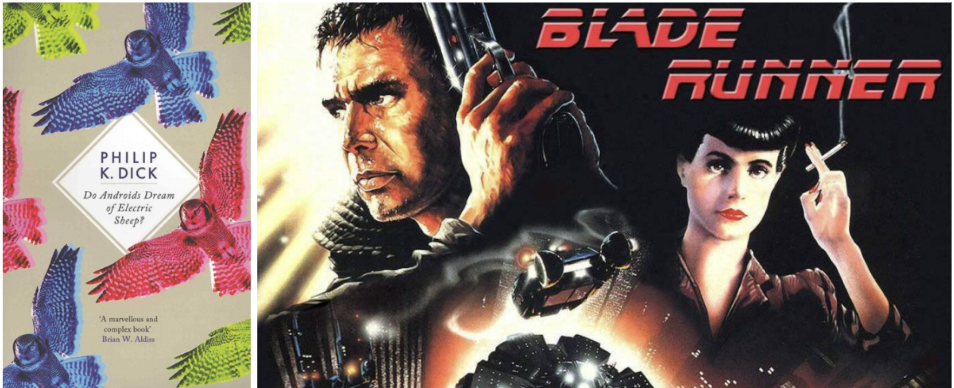
The front cover of the Weidenfeld & Nicholson version; the original Blade Runner film poster.

In the 1960s, the prodigious Science-Fi writer, Philip K. Dick, produced his far-sighted masterpiece, Do Androids Dream of Electric Sheep? This dystopia would become the template for Ridley Scott’s iconic 1980s film adaptation, Blade Runner, starring Harrison Ford. 

It is rather a prescient read with the explosion of AI into the mainstream, as PKD imagined a human world threatened by rogue androids, whose intelligence had become so sophisticated they had learned to reject the servile, exploitative role foisted upon them by their human masters. A set of bounty hunters within the San Francisco Police Department, including the protagonist, Rick Deckard, are tasked with eliminating this threat. 

Like many Sci-Fi worlds, the future San Francisco that PKD depicts is a bleak wasteland, choking with the “dust” following the fallout of a nuclear World War. The division between the haves-and-have-nots of this world is Stark (AKA Tony Stark, AKA Elon Musk, who would have all-of-us-who-can-afford-it blast off to live on Mars.) 

Bladerunner Trailer for its 30th Anniversary Release. 

In the novel, there has been a mass exodus from Earth and those who have the financial means to do so have escaped to live in the far reaches of the Solar System; those that remain, include the misfits and mercenaries who can make a quick buck in the black market economy, or others such as the downtrodden JR Isidore, a victim of the War, whose mental faculties have been diminished by the choking environment: fail the intelligence tests, and you are condemned to remain on the blighted Earth, performing the sorts of menial tasks which the robots are destined to take over. 

(So, ICHK students, focus on developing the range of technologies that make you uniquely human, reliable, able to work in a team, empathic, creative, and an indispensable problem solver…as well as pass your IGCSEs/IB exams. No pressure…)

In such a barren landscape, nature has been largely destroyed. The very few animals that remain command exorbitant prices from the animal traders who peddle them in exclusive shops with eye-watering price tags. They have become the ultimate commodity, replacing some elements of our society’s desire for shiny new objects such as Tag Heuer watches, Gucci handbags, and the various other talismans with which we humans adorn ourselves- perhaps as protection against the inevitability of the human condition?

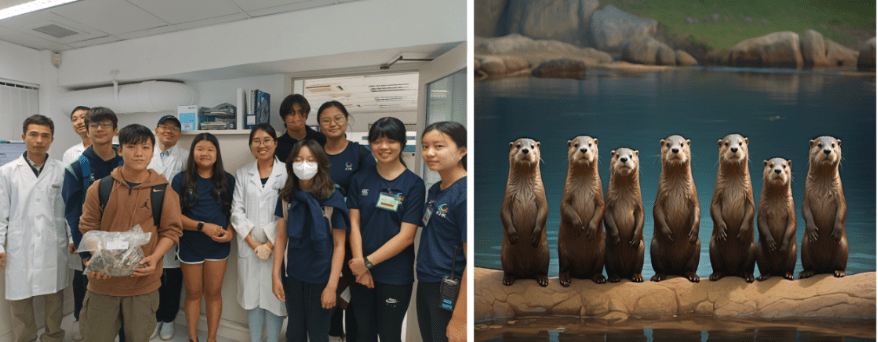
There are estimated to be fewer otters in Hong Kong- seven- than the number of ICHK students in the photo on the left with Kadoorie Farm scientists.

Last term, we were lucky to be invited to Kadoorie Farm to hear about the plight of pangolins. We met with researchers such as Aiko Leong, the female scientist in the centre of the picture who was engaged with analysing traces of otter DNA found in stools, and other scant samples to try to establish patterns of movement and population numbers etc. Work conducted by students at HK University led the researchers to conclude there are an estimated seven otters left in Hong Kong. Yes, I thought I misheard too. Not seventeen. Seven. You can read more about that in this excellent feature article: https://www.kfbg.org/en/KFBG-blog/post/In-search-of-the-last-otters-of-Hong-Kong

The electric sheep that grazes on the rooftop of Rick Deckard’s flat is his prized possession, but he longs for the day where he might be able to not just gaze at the real rabbits, goats and giraffes for sale beyond the shiny glass shopfronts and purchase his very own status symbol to show off to his neighbours. 

Global biodiversity loss as a bi-product of human activity has been documented by groups such the World Wildlife Fund, who state that we are now living in an age known as the Sixth Mass Extinction; within Hong Kong we have creatures such as pangolins, pink dolphins and otters who are hanging on by a thread. In a follow up to this piece, I will reflect further on the precarious systems in balance and the strategies and technologies that have been proposed if we are to be successful in- hopefully- ensuring that these species survive, as well as ensuring the flourishing of the dignity and prosperity of human life. 

But if we aren’t, maybe in the future you might covet finding an electric otter wrapped up under the Christmas tree.

A thin slither of mangroves and fish and shrimp ponds that constitute the Mai Po Marshes stand in stark contrast to the mega-city of Shenzhen. Land cleared for development is visible. 

We are at an age where certain aspects of science-fiction have been replaced by science fact. In the novel, the “Voigt Test ” is administered by officers looking to ascertain whether the “person” they are speaking with has the necessary empathic qualities to indicate they are actually human. Some AI robots today have already passed the Turing Test, and are becoming increasingly sophisticated to the point where they might also be likely to pass whatever empathy tests might exist in the near future.

Indeed, to a perturbing extent, we must now operate like Deckard, although we don’t have the advantage of his sophisticated testing systems. We need to be able to apply a critical rationale based upon our own intuitions and reasoning if we are to detect fact from fake. We are the guinea pigs in a new digital age, conditioned to speaking, and revealing our preferences, to Alexa, Siri, or the chatbot on the bank app etc. 

(l-r) Professor Ian Wilmut with Dolly the sheep, the world’s first cloned animal; a “Tamagotchi”, a massively craze electronic animal toy in the 1990s (it’s highly probable some of your parents owned and accidentally killed one); “Come give me a hug!” Robots today are being developed with empathic traits, such as Osaka University’s Affetto infant.

Then, there’s the rather malign development of AIs that will purport to be our friend, and lend a sympathetic ear to young people who might find themselves increasingly isolated from others owing to an overreliance on tech, either through their own “choice” (the reality is that the algorithms that underpin these seemingly benign technologies are designed to be addictive to commodify your attention), or due to the pressures of family life where mum and dad are working late, so solace is found through staring at their smartphone screens. 

Here, once again, PKD showed remarkable foresight as the “mood organs” that characters dial into to synthesise their daily emotional experience is much like the real invention of the dopamine-delivering technologies that almost all of us carry in our pockets. Dick’s characters search for connection and empathy within, or away from, their world through the Empathy Machines which they can plug into; these machines allow them to feel that they are momentarily like Mercer, the suffering god of their world. In a world otherwise bereft of hope it serves as some sort of spiritual escapism to escape the drudgery and meaningless of their own existence.  

Do Androids Dream of Electric Sheep? Is a fantastic novel, brimming with ideas, many of which feel like they have already come somewhat true, just 56yrs after it was written. As a modern reader, we might use the text to stimulate our own thought experiment as to what the future might hold, and how we should act in it. Some of the technologies and risks that PKD predicted have already arrived. (I do wish they would hurry up with the flying cars, though…)

A graphic novel version of PKD’s seminal science-fiction novel will shortly be appearing in the library..!

Links and Citations

https://www.independent.co.uk/news/science/dolly-parton-scientist-scientists-university-of-edinburgh-b2409178.html

https://www.kfbg.org/en/KFBG-blog/post/In-search-of-the-last-otters-of-Hong-Kong

https://mashable.com/article/blade-runner-which-version-watch

https://theconversation.com/ai-is-closer-than-ever-to-passing-the-turing-test-for-intelligence-what-happens-when-it-does-214721

https://www.theverge.com/2012/7/26/3188043/robot-baby-osaka-university-asada-laboratory

https://www.worldwildlife.org/stories/what-is-the-sixth-mass-extinction-and-what-can-we-do-about-it

Youtube: Bladerunner Trailer for its 30th Anniversary Release.