
with Liz Rose-Jeffreys and Y9/10 ICHK students.
By Jon Rees; Edited by Liz Rose-Jeffreys. March 8th, 2024.
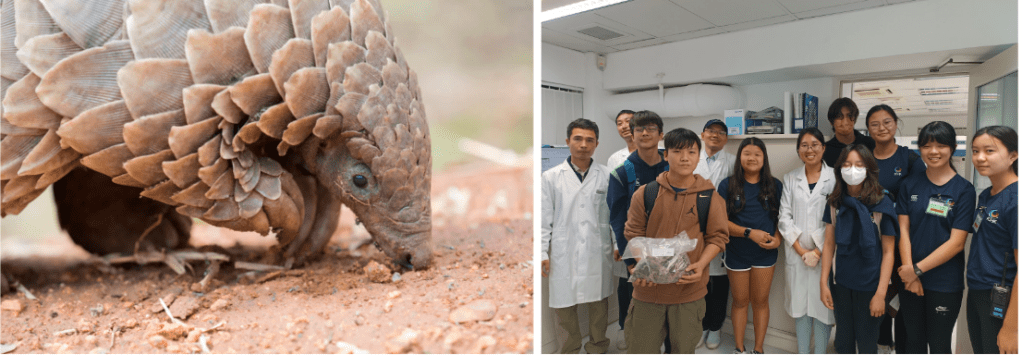
Photo: BBC Wildlife; Kadoorie Scientists and ICHK students
This week, Y9 and Y10 students from ICHK travelled the short journey to the world-renowned conservation centre, Kadoorie Farm Botanical Garden (KFBG), to hear a fascinating talk about one of Hong Kong’s most critically endangered species, the Chinese pangolin.
Resident expert, Liz Rose-Jeffreys, who also works with ICHK parent, Paul Crow, in the reptile research and relocation facility, shared some fascinating information about this beautiful, peaceful creature- it has no teeth, so can’t bite, sucking up ants and termites with its 40cm long tongue, and rolling into a ball when threatened.
However, Rose-Jeffreys also revealed some shocking and demoralising statistics about a species that in Hong Kong, and around the world, is teetering on the verge of extinction.
Before we get to that, a good news story: last year, Kadoorie Farm took in 1,600 snakes that had either been rescued because they were injured, or needed to be relocated as they had slithered too close to human habitation. Although more snakes are received during the warmer months, that works out at an average of nearly 5 a day- and the great majority of these are released once they’ve been identified and health checked. It’s a very healthy indicator of the biodiversity that does exist throughout the city’s country parks.
So, how many pangolins do you think that Kadoorie Farm takes in by way of comparison? Well, the answer is shockingly low, and an indicator of how very rare they are here: since 1997, the Kadoorie facility has only received 15 pangolins, and they were only able to release 10 of these back to the wild (in extremely secret locations to try to give them the best chance of survival).
We were able to see some charming footage of one of their most recent residents back in 2020; Liz revealed a funny and touching anecdote, that when the pangolin was trying to balance on the wooden log placed in its enclosure it fell off- face first into its food bowl!- and while there, realised that eating was actually a good idea, so it started to chomp away after a period of shock and readjustment to its circumstances.
At the end of Liz’s excellent talk, we were able to then see some samples of scales that had been seized by customs officials and donated to KFBG under special permission and held under permit, for education and research purposes.
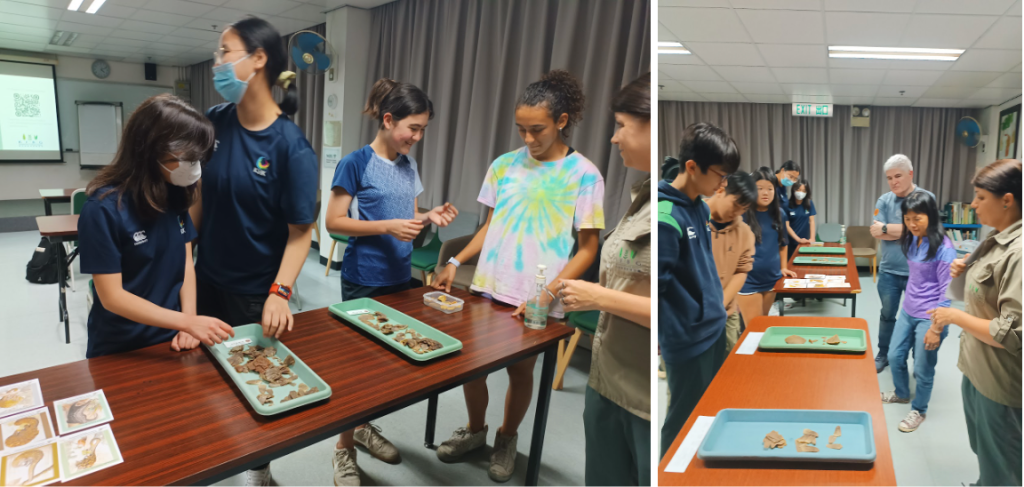
Left: Charis, Anna, Jazzy and Kenza examine the scales from various species of pangolin. Right: Under the guidance of Liz Rose-Jeffreys, Angus and Nathan, along with Christian and Stella Pilard of Eco-Sys Action Foundation, inspect some more samples.
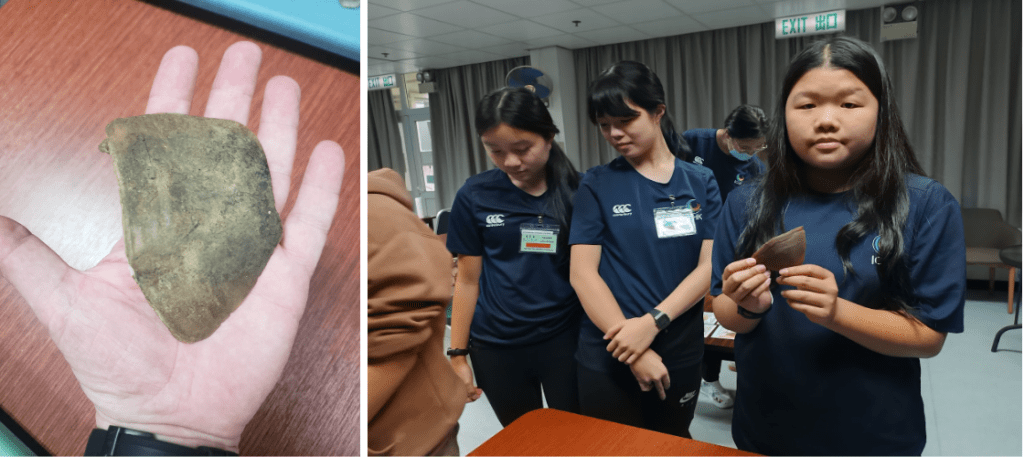
Jasmine and Fafa look on as Haile holds up the enormous back scales of the giant pangolin, found in regions of western and sub-saharan Africa. Scientists (L-R): Huarong Zhang, Benny Lai, Peter Yang, Aiko Leong. Students (L-R): Angus Ho, Nathan Cheung, Haile Cheng, Max Lefevre, Charis Chan, Anna Zhou, Fafa Wong, Jasmine Chow
The team of scientists at Kadoorie’s DNA/Genetics research centre are a remarkable group. We were lucky to meet them after the talk and hear about their work in their laboratory. (Aiko Leong’s work on otters is an excellent story I would like to focus on next time…) These guys are proper superheroes going about their work with quiet dedication and humility.
They were “rewarded” too with discovering a new species- that of the Asian Mystery Pangolin. Through testing of scales seized by customs officials, which included the scales and a claw from the back foot of one sample they received, they realised the genetic codes did not match any of the 8 known species- and so, a new species had been discovered! Yet, in a very sad way, the reason it is called the Asian Mystery Pangolin is because no-one has ever seen one in real life, only in fragments taken from a trafficking shipment. Their research paper is linked here if you’d like to take a look: “Genomic analysis reveals a cryptic pangolin species”.
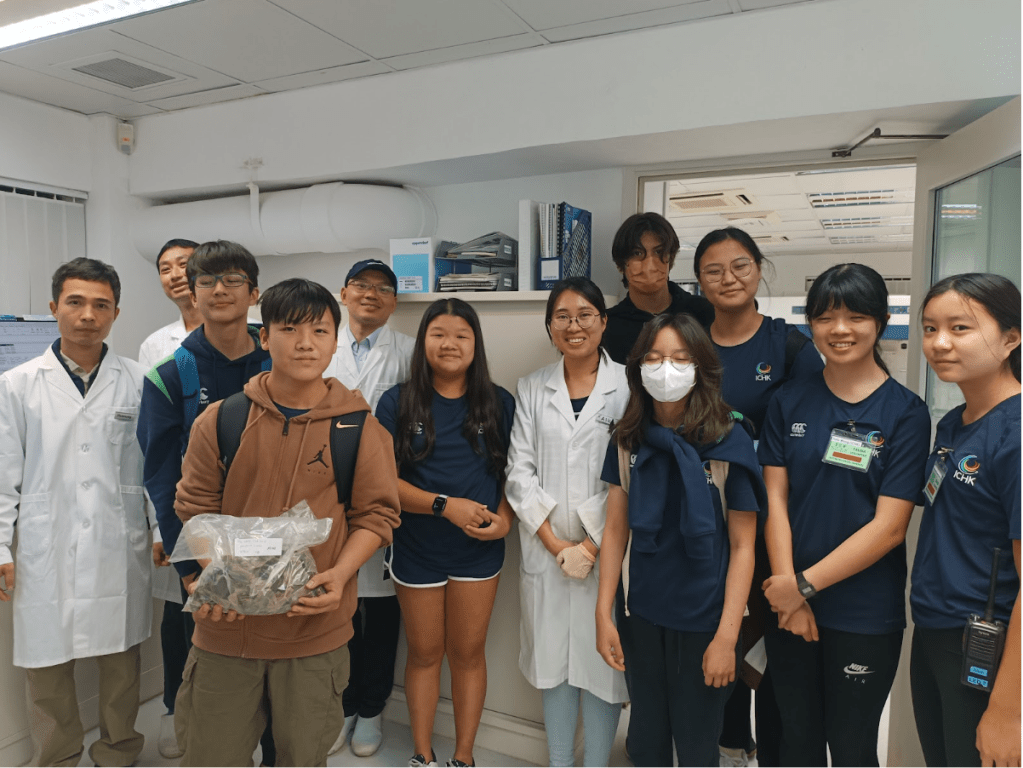
In the team photo above, Nathan is holding a bag of around 1.5kg of scales. Rose-Jeffreys told us that 1,000kg of scales would equate to around 1,700 dead Chinese pangolins, although this figure does vary depending on the species. And in one shipment alone Hong Kong customs officials confiscated about 8,000 kilos of scales, which could mean about 14,000 dead pangolins.
The scale of the global operation is vast, and the criminal gangs who smuggle these animals (dead and alive) are highly sophisticated. An excellent expose by a young Vietnamese investigative journalist was recounted to me by Mr. Holland, and I post it here for anyone who would like to take a look. “Van”- her real name is concealed because of the threat to her life- took part in a 4 year investigation, and with incredible bravery and execution, eventually coaxed one of Nigeria’s biggest dealers to reveal key details that led to law enforcement officers being able to bring to a halt a trading network that accounted for half the world’s pangolin sales.

Huarong Zhang and Peter Yang (Benny Lai on computer in background) display the scales attached to a claw retrieved from a seized shipment of pangolins that they analysed with their DNA testing machines, revealing a new, 9th species of pangolin, the Asian Mystery Pangolin
Amidst all of these thoroughly dejecting statistics and facts, Huarong Zhang and Peter Yang, state that they are somewhat hopeful that the situation can be turned around and the pangolins saved. They say that the volume of shipments coming through Hong Kong is starting to be reduced. Also, more awareness from the public due to the kind of work they are conducting is helping to educate people that the scales have no proven medicinal value as they are made of keratin- that’s exactly the same material as your fingernails. The fact that pangolin has been taken off the official list of traditional Chinese medicines in 2020 (SCMP/Green Queen) is another huge step to ensuring their survival, and hopefully revival.
Kadoorie Farm is a real success story and its principles are a perfect model for you students reading this article. The people who work for this organisation are principled, knowledgeable, empathic and proactive.
Jasmine, Fafa and Max have been very lucky to conduct their work experience in such a wonderful organisation, and are to be commended for their proactivity in acquiring their placements, and their excellent attitudes across their time there. I think we have a bright future of vets and conservationists with folks like these.
And a huge thanks also to our Y10 Work Experience programme partners, Christian and Stella Pilard at Eco-Sys Action Foundation, who also run The Little Museum of the World- a Museum for Building Peace, and who have hosted Leo Birnbaum and Angus Ho. They couldn’t be under the guidance of two more compassionate and kind people, and I was assured that both young men had been excellent ICHK representatives.
Christian helped to organise the event at Kadoorie and he and Stella were in negotiations with HK authorities for weeks so that they could acquire some pangolin scales to feature alongside the hundreds of other objects in their collection that tells the story of our planet and our species. With people such as these- there’s hope!
 Sustainability, Human Technologies and Theory of Knowledge