
HUMAN TECHNOLOGIES AND TOK
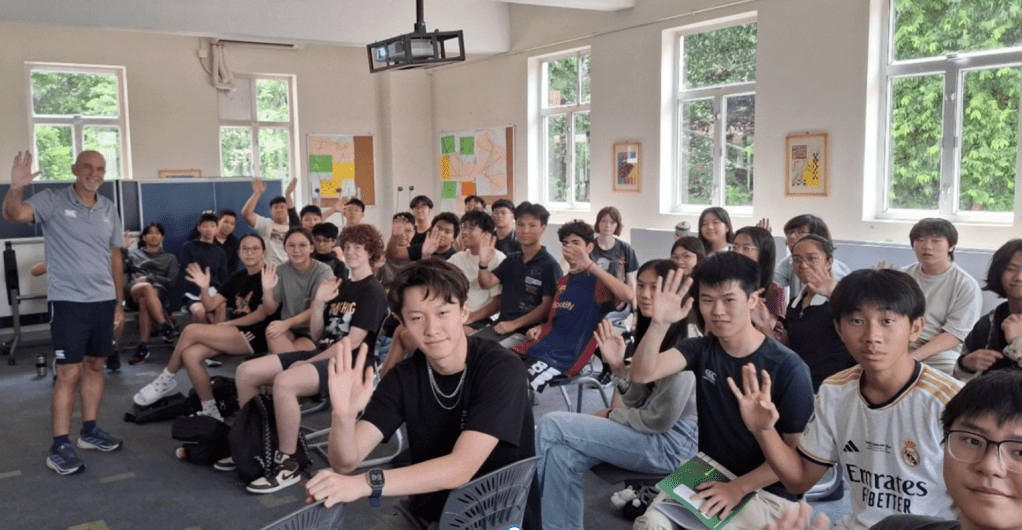
Last week, Executive Head of School and Human Technologies progenitor, Toby Newton, delivered an excellent talk to our Y12 students, pointing out the ways in which their Human Technologies curriculum had prepared them for some aspects of their IB Theory of Knowledge course.
Deputy Head of School, Flora Lai, pointed out some of these pathways in her pertinent article published in last week’s Bulletin which you can read here; it was a real bonus for our Y12s to get a lifetime’s worth of insights about evolutionary biology, human nature and cognition distilled to one hour and then connected to TOK.
It might be argued, the way in which TOK focuses on just 5 Areas of Knowledge reinforces an outdated notion of academia as “siloed” off into different disciplines, a notion reinforced by the physical architecture of university departments which still houses different subjects such as The Arts, The Sciences, The Humanities in separate buildings. Today, though, this compartmentalisation of areas of study seems increasingly outdated. An ecologist, for example, must base her scientific data on precise mathematical calculations, as well as have a nuanced understanding of Systems Thinking to understand the complex range of climatic, economic, and societal issues that impacts her topic, as well as use inter-social and computing skills to first gather, then communicate her research.
Human Technologies can be described as a guidebook for living, and its moving horizon (you can never arrive at the destination!) is to push lifelong learners towards the pursuit of “The Good Life.” But so many schools today focus merely on academic performance, and do not give the students a chance to explore their own values and identity – how they are wired, and the implications of this to identity formation, and then how to develop their own sense of self-agency as they encounter the world.
To prepare students for this complex world, Toby created, and then collaborated with like-minded individuals to evolve the HT course to address what he believes should be essential concepts within a modern educational system that speaks not just to the narrow aims of exam success. On this occasion he chose the work of Etienne Wenger to illustrate this point:
Education, in its deepest sense and at whatever age it takes place, concerns the opening of identities – exploring new ways of being that lie beyond our current state. Whereas training aims to create an inbound trajectory targeted at competence in a specific practice, education must strive to open new dimensions for the negotiation of the self. It places students on an outbound trajectory towards a broad field of possible identities. Education is not merely informative – it is transformative.
Etienne Wenger, Communities of Practice
Toby pointed out in his talk that we are meaning making creatures. We see patterns in the constellations and can use the capacity of our evolved consciousness to construct entire systems of religions and mythologies out of the starry skies. And our future selves, similarly, can be formed from a galaxy of possibilities.

The future world is one that is going to be increasingly complex and interconnected. The era of global capitalism has led to human societies being inevitably intertwined; we also live in a dizzying age of semiotic potential constructed through the mainstream and social media. TOK can help students understand the various ways in which knowledge can be constructed, as well as refining some critical thinking strategies so that they can discriminate fact from fiction as it flies at us from the algorithmic superhighway.
Finding ourselves, understanding the physical and psychological forces that have shaped us, understanding who we are and how we have been encultured… and then learning that we have the capacity to take control of the direction of these beliefs, values, predilections and biases, to make lives of real meaning: that is the goal of Human Technologies. And Toby was explicit in asking the students to never forget these lessons.

 Sustainability, Human Technologies and Theory of Knowledge