
Human Tech: Dyadic Relationships- Forming Memories
We humans are highly complex beings: Our brains are said to have an average of 86 billion neurons and 85 billion non-neural cells. There’s 8 billion of us now, too, so we are a remarkably diverse, cognitively complex, and evolutionarily successful species. (https://www.pnas.org)
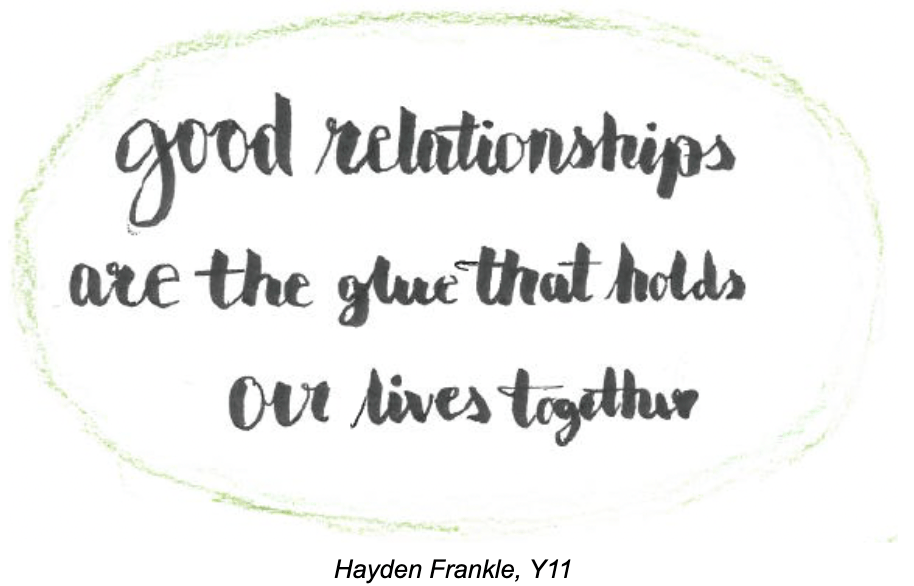
Hayden Frankle, Y11
However, rather surprisingly, a generic primate brain has approximately the same number of neurons as ours. So, while we are truly complex, we also bear surprising similarities to our primate cousins and other ‘K-strategist’ mammalian species (whales, elephants, primates) who have comparatively few young (to ‘r–strategist’ species such as frogs, salmon, turtles that give birth to hundreds of young at a time). And amongst all ‘K-strategists’, humans spend the longest time being nurtured and cared for, often by the mother, given the need for milk and nutrition, by whoever- parent, helper, guardian, grandparent- is the primary caregiver.
In Human Technologies, we are exploring “the art and craft of being human.” We want to put the lid up and peer into how our brains are wired- even delving waaaaay back into our evolutionary past, and engaging with ideas and theories from cognitive neuroscience and psychology- to better understand our own species and ourselves, and the sorts of habits, behaviours and social relationship patterns that define who we are, and who we want to become. Recently, we have been engaged with learning how human beings form their first memories and impressions of the world.
In the absence of language and with only rudimentary cognitive capacities, our tender young brains are still forming in the “fourth trimester” outside the womb, in a state of total, utter dependence on those providing our care.How we form our first expectations of what the world is like is based upon our relationships with our primary caregivers.
It will take some months or so before infants develop the sensory connections to be able to recognise the fleshy faces that float in front of their crib, and the earliest memories my Y11 class and myself could pin down were maybe when we were three years old…and these were often vague, dislocated, memories at best. The reason being, our prefrontal cortex that distinguishes our specific type of mammalian brain from other species and allows us to puff our chests out and declare ourselves, homo sapiens, (wise men), is still under development.
As we learn as babies, our cognitive apparatus is making stronger connections between patterns and expectations of behaviour. We come into the world with our own unique biogram, DNA, and a temperament which is distinguishable from our own brothers and sisters.

Vulnerable, but highly complex creatures, hardwired with a capacity to make meaning of their world.
Yet, we are not simply ‘blank slates’, for encoded in the complexity of our DNA and biograms, research presented by the American psychotherapist, Daniel Stern, is the capacity for making meaning of the world in our very early infant years through Representations of Interactive Generalisations (RIGs).
So, what are RIGS?
While a baby can’t yet either form the words “love”/”worry”/’hunger”/”comfort”, their primal calls for attention, and the response that follows from the caregiver, help them to form representations of whether the world will be a comfortable place where they are likely to be soothed and made to feel OK, or not. (Sadly, all too often, the research shows that children who do not develop a basic sense of “OK-ness” are likely to grow up more cautious and anxious of the world. Reasons for this are varied, but include the two temperaments of the baby and caregiver not aligning, or, babies who are born into situations of socio-economic hardship, so that attention is just hard to come by…)
A baby can understand that a hug represents love and protection. And if a pattern of hugs and care occurs across time, then that baby is building a series of connections that are already affecting how he/she will come to the world.
To understand these ideas, students were introduced to the captivating snow art of the Canadian artist, Simon Beck. You can check out his beguiling masterpieces here, where he uses the vast white snowfields of Banff National Park to create his huge murals which embrace and compliment the richness of the natural setting in which they are created.

With one footprint after another, eventually patterns of connection and meaning start to emerge in the snow.
Our students enjoyed artistically representing this visual metaphor through the creation of marble-art pieces, where one marble, dipped in paint was rolled across the white page. They attempted to roll the next marble along the same ‘pattern of connection’, and the results were very beautiful, but also a very useful symbolic representation of the learning that took place within the unit.
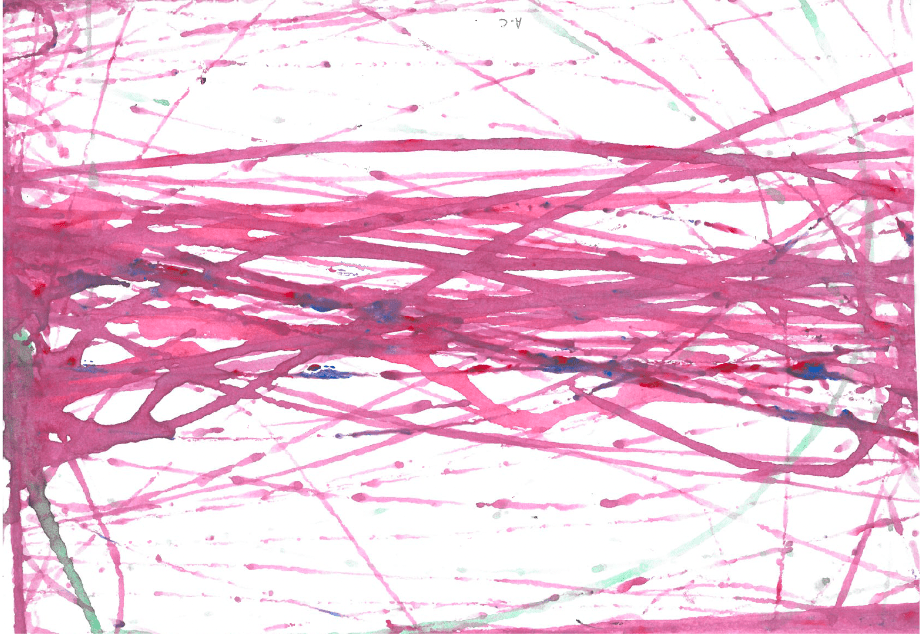
Amelie Chan, Y11, Marble Art to show of Representations of Interactive Generalisations
What we are really keen for students to understand is that if we extend the snow footprint metaphor further, they are still so young and their capacity for self-agency is now coming to the fore; my Y11 class increasingly have the language, rationality and wisdom to make more independent decisions.
While the very nature of us as ‘K-strategists’ means that we have been totally dependent upon the decisions of our primary caregivers to take us to this point, students can now start to push back upon the world and make decisions not only about the here-and-now, but the ‘Self-2’ that they want to become in the future.
Given the teenage brain’s vast plasticity and capacity for learning not merely academic content, but the no-less beneficial social technologies that will give their lives meaning, purpose and value, they still have time to realign their focus, adopt new habits and behaviours, to create new ‘footprints in the snow’, that, over time will become new conceptions of how they perceive and act in the world.
To know the ways in which we are hardwired as a species, gives students real insight to that age-old maxim to “know thyself” in a way that is pragmatic and objective, without being too self-critical; also, by recognising the myriad differences between ourselves and others we can hone our sense of empathy and understanding. These are skills that, according to Attachment theory specialist, Dr. Joanne Wu, allow us to “improve our relationships and our well-being”. Read that again. That’s like a superpower. That’s what schools could/should be about. Give me that- the ability to improve my relationships and my well-being- over a narrow fixation on scores/results anyday.
 Sustainability, Human Technologies and Theory of Knowledge